
Siemens Medical Solutions' syngo Suite
It may sound like a good thing, but most people know that when an item claims to be “one size fits all,” it usually means “one size fits all… kind of.” Apparently, as in the clothing industry, this is equally true in the world of enterprise PACS.
“You can’t make everybody happy,” said Tim Masters, PACS manager for Continental Division HCA of Denver.
Four years ago, Masters was in charge of implementing GE’s Centricity PACS at Sky Ridge Medical Center, a then brand-new 136-bed hospital on the outskirts of Denver in Lone Tree, CO.
In fact, he said meeting everyone’s expectations — whether they were doctors or nurses working in the OR, ED or ICU — was the biggest challenge he came across during his time at Sky Ridge.
“Even though you go to a group of five doctors and four of them want it one way, the fifth one will throw a wrench in it,” Masters said. “And he’ll have totally valid reasons for the way he does things. There’s definitely a challenge in meeting everyone’s expectations of the system.”
Jeffrey Broz, RIS/PACS administrator for Alegent Health in Omaha, NE, said he understands the problems associated with implementing a system that satisfies everyone across the board. When replacing his hospital’s analog systems with Siemens’ syngo Suite, he had a hard time just convincing physicians the change was needed.
“They had to change the way they interacted with imaging,” he said. “Some were savvy and had been waiting for the technology, but others were polar opposite and we dragged them along kicking and screaming.”
The Faster the Better
Masters said he knew that when his team approached the task of seamlessly moving images across the enterprise, it needed to make sure the images got to every critical area up front.
“We wanted to make sure that any physician, be it an ED doctor, an OR surgeon, a clinician in the ICU or the referring physicians out in their offices had access to these images as soon as they became available,” he said.
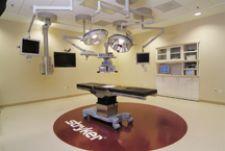
Sky Ridge has eight ORs, and Masters said he was able to tie the Web directly into a Stryker overhead boom system in each room along with another one in the nurse work area.
“The monitor could actually bring up a PACS, endoscope or fluoroscopy image, depending on what [the physicians] were doing,” he said. “Or they could bring PACS up on all three monitors — it was really key in their workflow.”
He said the screen’s placement was especially convenient for physicians who preferred to work on different sides of the table.
For Broz, the technology was “very well received” in the OR.
“Any time you can decrease the amount of time from image acquisition to the time the surgeon can view the image, it’s an easy sell,” he said. “Prior to PACS, the film turn around time was approaching six to seven minutes — we were able to get that down to around one to two minutes.”
Much like Sky Ridge, Broz said many of Alegent’s OR rooms had the Web tied into the Stryker boom system, which helped speed up image acquisition time.
“With the system, you can move images from monitor to monitor until you like where things are located,” he said. “You learn very quickly that very few surgeons are the same.”
The biggest challenge in ED PACS is that physicians don’t have a lot of time to sit down, log in and type in a patient’s name, according to Masters — they need a solution that moves fast.
“We actually deployed a clinical license for Centricity and made it look very similar to the radiologists’ version of the software,” he said.
His team created a program that could automatically present a worklist of patients that were in the ED, allowing physicians to skip the extra steps of logging in and typing a name to access images.
Sky Ridge’s ED also had a wall-mounted computer with a boom system so the trauma surgeon could bring images up at the bedside in the trauma room without having to go out to the back dictationary, where the other workstations were.
Broz said quick image transfer and seamless access were important when planning a PACS-friendly ED.
“When a patient has an imaging test ordered by the ED, the images have to beat the patient back to the ED,” he said. “If that patient is transferred to the ICU, there is an auto-routing trigger that moves the images and relevant priors to the ICU.”
Alegent has an in-house intensivist all day, every day, Broz said. With PACS, every test a patient has had since arriving is available to the physician from anywhere.
In Sky Ridge’s ICU, Masters said Web software was strategically developed so the doctor could bring up a patient’s images at any PC.
“The big thing for the ICU is that we wanted a wide distribution because it’s in two separate areas, and we didn’t want to restrict that to one dictation area where they would have to go to the patient’s room, come back to view, make notes and then go back into the patient’s room again,” he said.
PACS Priorities
Broz has one major piece of advice for purchasing teams considering enterprise PACS implementation:
“Without a doubt, implement RIS first,” he said. “RIS is the logic behind the system. PACS should be nothing more than a dumb image viewer — the RIS controls prior fetching, routing and verification.”
Masters also said RIS implementation is important, but in his experience the number one priority was making sure the hospital had a detailed image distribution strategy.
“Specifically what we’re talking about here is how we get those images to the key clinical areas,” he said. “Make sure that you have a solid vendor management program and know what you’re getting into as far as maintenance and support and uptimes are concerned.”
He also said the incorporation of some type of project management oversight is extremely important.
One “key point” Broz said is making sure to develop a diverse steering committee that reports back to its user community.
“Be sure OR, ED, ICU, nursing and referring physicians are all included,” he added. “This is a great panel of folks to validate hypotheses. Sometimes what you think is a good idea is not. You face it, gather new information and move on until you reach an acceptable solution for all.”
 March 06, 2024