Photo: GE Healthcare
Nov. 3, 2025 — GE HealthCare and AliveCor recently announced the world’s first clinical go-live of the integration between GE HealthCare’s MUSE Cardiology Information System and AliveCor’s KardiaMobile 6L electrocardiogram (ECG) device at Hannover Medical School (MHH), Germany. The collaboration aims to optimize patient care and reduce hospitalizations linked to cardiac events by expanding care outside the hospital with remote patient monitoring*.
“This is a major step forward in bringing cardiac rhythm care closer to the patient,” said Prof. Dr. David Duncker, Head of Hannover Heart Rhythm Center at Hannover Medical School. “By integrating remote ECG data into our clinical systems, we can improve diagnostic speed, reduce follow-up workload, and enhance coordination of care.”**
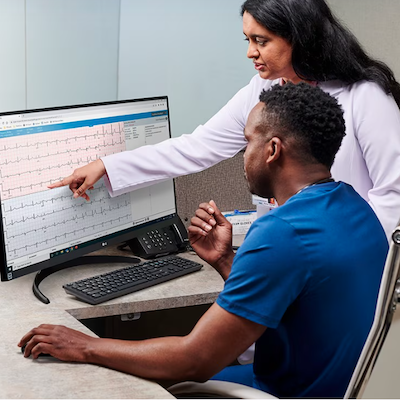
Patients can use KardiaMobile 6L to record medical-grade single-lead and six-lead ECGs from home or other remote locations, aiming to reduce the need for in-person hospital or clinic visits3. Through this clinical integration by MHH, these recordings are securely and seamlessly integrated into the hospital’s existing workflow through GE HealthCare’s MUSE Cardiology Information System. MHH physicians are able to access, evaluate, and compare KardiaMobile 6L ECGs and in-hospital and clinic ECGs in near real time***, supporting faster clinical decision-making and continuity of care, while also giving patients peace of mind that their physicians may have the opportunity to review their ECGs promptly.
With MUSE, ECGs acquired using KardiaMobile 6L are automatically routed into the electronic medical record at MHH, eliminating manual data entry and supporting efficiency gains. One study found that using KardiaMobile for remote patient monitoring reduces the need for in-person ECGs and other cardiac assessments, enabling clinicians to deliver care more efficiently without adding to their workload.3
KardiaMobile 6L is clinically validated to detect atrial fibrillation, and other arrhythmias - conditions associated with significant hospitalizations and mortality worldwide. Atrial fibrillation is now the most common sustained4 cardiac arrhythmia in Europe, affecting over 11 million people1 and contributing to 8.4 million disability-adjusted life years (DALYs) globally.2 By enabling patients to capture medical-grade ECGs from home or remote locations, the integration expands access to diagnostic data, supports decentralized care models, and may help reduce avoidable hospital visits.
The collaboration between GE HealthCare, Hannover Medical School and AliveCor underscores a shared commitment to advancing connected, patient-centric cardiac care. By combining mobility, precision, and interoperability, the collaboration helps clinicians deliver more timely, informed, and coordinated care.
“We at GE HealthCare are proud to highlight our collaboration with AliveCor and Medical School Hannover, which exemplifies the power of combining cutting-edge technology with visionary clinical leadership. Together, we are bringing our solutions that push the boundaries of what’s possible in healthcare - merging GE HealthCare and AliveCor’s technologies and deep expertise with MHH’s pioneering research and clinical aspirations. This collaboration reflects our shared commitment to innovation without limits, delivering meaningful impact for patients, providers, and the future of care,” said Balázs Pozsony, Cardiology General Manager International, GE HealthCare.
“We’re thrilled to join forces with GE HealthCare and Medical School Hannover, blending AI innovation, precision technology, and world-class research to reimagine cardiac care and move healthcare forward,” said Simona Esposito, SVP of Sales, Global Markets at AliveCor. “This partnership is about more than technology - it’s about making a real difference for patients, empowering providers, and expanding diagnostic capabilities across the cardiac care pathways.”
For more information on GE HealthCare’s MUSE NX and diagnostic cardiology solutions, visit www.gehealthcare.com/products/diagnostic-ecg/muse-nx.
To learn more about AliveCor, visit alivecor.com
References
1. Velleca M, Costa G, Goldstein L, Bishara M, Boo LM. A Review of the Burden of Atrial Fibrillation: Understanding the Impact of the New Millennium Epidemic across Europe. EMJ Cardiol. 2019;7(1):110-118. Available from: www.emjreviews.com/cardiology/article/a-review-of-the-burden-of-atrial-fibrillation-understanding-the-impact-of-the-new-millennium-epidemic-across-europe/
2. Global Burden of Disease Study 2019. Atrial fibrillation and flutter – Level 3 cause. The Lancet. Published online 2020. Available from: www.thelancet.com/pb-assets/Lancet/gbd/summaries/diseases/atrial-fibrillation.pdf
3. Lambert CT, Patel D, Bumgarner JM, et al. Atrial fibrillation future clinic. Novel platform to integrate smart device electrocardiogram into clinical practice. Cardiovascular Digital Health Journal. 2021. Available from: https://pmc.ncbi.nlm.nih.gov/articles/PMC8890049/
4. Zhou M, Wang H, Wang Z, Li Y, Li Y, Liu S. Global, regional and national burden of atrial fibrillation and its attributable risk factors from 1990 to 2019: Results from the Global Burden of Disease Study 2019. BMC Public Health. 2022;22:14403. Available from: https://doi.org/10.1186/s12889-022-14403-2
Disclaimer
*This product does not generate alarms or alerts for physicians related to ECG data sent from the remote location to the electronic medical record.
**The statements by GE HealthCare’s customers described here are based on his/her own opinions and on results that were achieved in his/her unique setting. Since there is no “typical” hospital/clinical setting and many variables exist, i.e., hospital size, case mix, staff expertise, etc., there can be no guarantee that others will achieve the same results.
***Actual time may vary slightly due to hospital network and processing times.

 December 23, 2025