
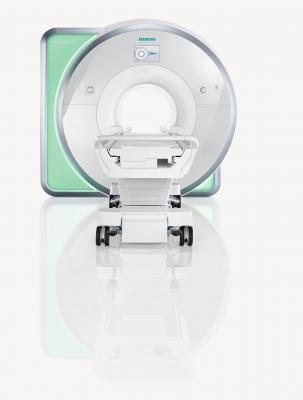
February 21, 2017 — Siemens Healthineers announced that the U.S. Food and Drug Administration (FDA) has cleared the company’s Compressed Sensing magnetic resonance imaging (MRI) technology. Compressed Sensing slashes the long acquisition times associated with MRI to enable dramatically shortened scans. For example, cardiac cine imaging with Compressed Sensing can be completed in just 16 seconds rather than the traditional four minutes, courtesy of an algorithm that reduces the required amount of data.1
Compressed Sensing enables MR images of diagnostic quality using fewer data points. Iterative methods enable reconstruction of high-resolution MR images with no loss in information. Additionally, the efficient inline reconstruction algorithm of Compressed Sensing supports a high degree of clinical throughput. The acquired data are calculated directly at the MRI scanner, with no need to export or externally process that data.
In cardiac imaging, Compressed Sensing Cardiac Cine takes full advantage of this inline reconstruction algorithm. Rather than hold their breath 10 to 14 times over a four-minute period, patients are able to breathe freely, with images acquired in roughly 16 seconds. Motion artifacts created by breathing and heartbeats are effectively eliminated, which benefits older and critically ill patients who are unable to hold their breath.
The speed of Compressed Sensing Cardiac Cine also enables new patient groups, including those with cardiac arrhythmias, to access cardiac MRI for the first time. Where low diagnostic quality once prevented these patient subsets from realizing any benefit from cardiac MRI, the adaptive triggering of Compressed Sensing permits recording of the entire cardiac cycle – including the late diastolic phase – in real time with only one breath-hold. Also, Compressed Sensing Cardiac Cine images can be used to accurately quantify left ventricular function.
Compressed Sensing is available on the Magnetom Aera 1.5 Telsa (1.5) and Magnetom Skyra 3T MRI scanners from Siemens Healthineers.
For more information: www.usa.siemens.com
References
1. Kido, et al. Journal of Cardiovascular Magnetic Resonance (2016).
 November 05, 2026