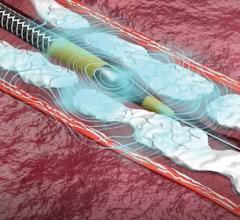
November 1, 2017 — The double kissing (DK) crush two-stent technique was associated with a lower rate of target lesion failure at one year compared with provisional stenting (PS) in the treatment of true distal bifurcation lesions of the left main artery, according to a large-scale randomized trial.
Findings were reported at the 29th annual Transcatheter Cardiovascular Therapeutics (TCT) scientific symposium, sponsored by the Cardiovascular Research Foundation (CRF), Oct. 29-Nov. 2 in Denver. The study was also simultaneously published in the Journal of the American College of Cardiology.
Provisional stenting (PS) is the most common percutaneous coronary intervention (PCI) technique used to treat distal left main (LM) bifurcation lesions. In previous studies, the double kissing (DK) crush two-stent technique improved clinical outcomes in LM bifurcations compared to culotte stenting and also in non-LM bifurcations compared to PS. The DK crush technique has never been compared to PS in LM bifurcation lesions in a random fashion.
DKCRUSH-V randomized 482 patients from 26 centers in five countries (China, Indonesia, Thailand, Italy and the United States) with true distal LM bifurcation lesions (Medina 1,1,1 or 0,1,1) to either DK crush stenting (N=240) or PS (N=242). The primary endpoint was the one-year composite rate of target lesion failure (TLF; cardiac death, target-vessel myocardial infarction (TVMI), or clinically-driven target lesion revascularization (TLR)). Routine 13-month angiographic follow-up was scheduled after the primary endpoint was determined.
The technique was successful in 100 percent of the DK group and 97.1 percent of the PS group. The study found that TLF within one year occurred in 12 patients (5 percent) assigned to DK crush and 26 patients (10.7 percent) assigned to PS (HR 0.42, 95% CI 0.21-0.85, P=0.02). Compared to PS, DK crush also resulted in lower rates of TVMI (0.4 percent vs. 2.9 percent, P=0.03) and definite or probable stent thrombosis (0.4 percent vs. 3.3 percent, P=0.02). Clinically-driven TLR (3.8 percent vs. 7.9 percent, P=0.06) and angiographic restenosis within the LM complex (7.1 percent vs. 14.6 percent, P=0.10) tended to be more frequent with PS compared to DK crush. There was no significant difference in cardiac death between the groups.
“In this trial, PCI of true distal LM bifurcation lesions using a planned double kissing crush two-stent strategy resulted in a lower rate of TLF at one-year compared to provisional stenting,” said Shao-Liang Chen, M.D., Ph.D. Chen is director of cardiology and cath lab at Nanjing First Hospital, vice president of Nanjing First Hospital, Nanjing Medical University, and professor of internal medicine and cardiology at Nanjing Medical University in Nanjing, China. “These results indicate that double kissing crush may be a better option for these patients.”
The DKCRUSH-V trial was funded by a grant from the National Science Foundation of China (Funding no.: NSFC 91639303), and jointly supported by Nanjing Municipal Medical Development Project, Microport, Abbott Vascular and Medtronic. Chen reported nothing to disclose.
For more information: www.tctconference.com
Related TCT Content
TCT Announces 2017 Late-breaking Clinical Trial Presentations

 August 28, 2026