March 5, 2023 — Patients with complex coronary artery disease who underwent a stenting procedure guided by intravascular imaging were nearly 40% less likely to die of heart disease, have a heart attack caused by a new blockage in the treated artery or need a repeat stenting procedure in the treated artery, compared with similar patients who underwent a standard angiography-guided stenting procedure, according to research presented at the American College of Cardiology’s Annual Scientific Session Together With the World Congress of Cardiology.
“Our study shows that the use of intravascular imaging devices to visualize the interior of narrowed coronary arteries improves outcomes after stenting,” said Joo-Yong Hahn, MD, PhD, professor of cardiology and medicine at Sungkyunkwan University School of Medicine in Seoul, South Korea, and lead author of the study.
The insertion of a stent (a tiny metal tube, usually coated with slow-release medication to help prevent repeat narrowing or blockage) into a coronary artery is a minimally invasive alternative to cardiac bypass surgery for people with a coronary artery that is blocked or partially blocked by a buildup of fatty deposits (plaque). Some types of coronary artery blockages, however, are more challenging to treat with stents. This may be because a blockage is unusually long, calcified or located in a difficult-to-reach spot such as near the junction of the coronary artery and the aorta. People with such complex coronary artery blockages are at increased risk for experiencing a heart attack or a blood clot in a stent or for needing a repeat stenting procedure.
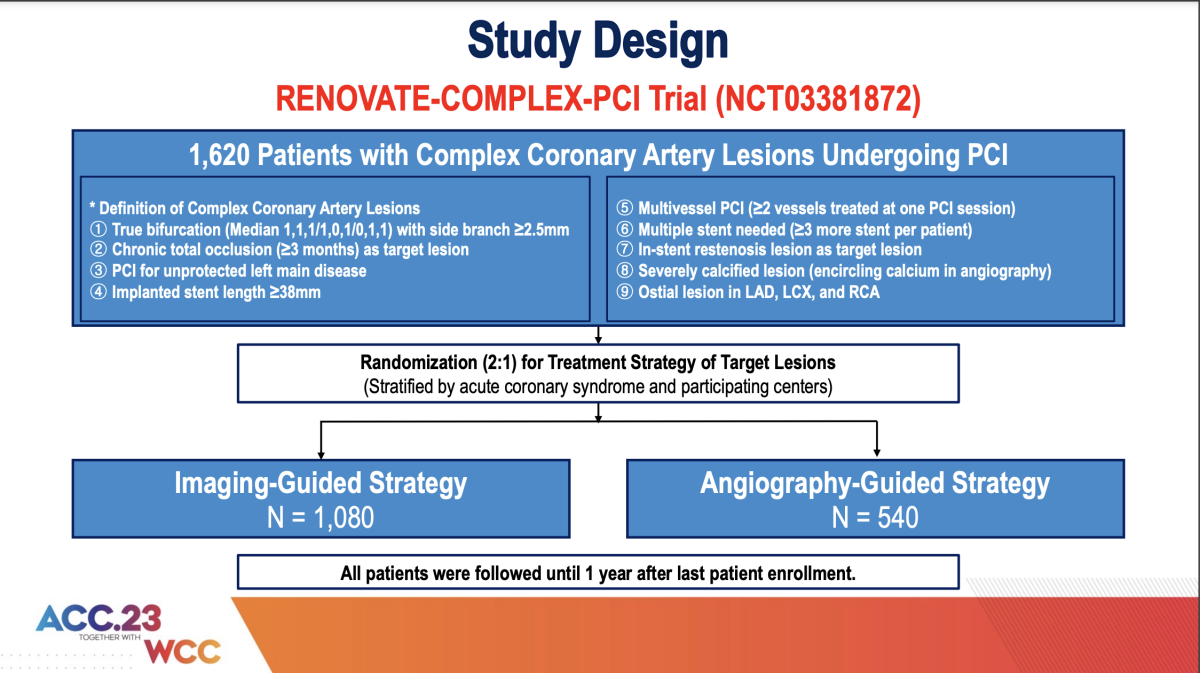
Angiography (a heart X-ray) is the standard technique used to assess the extent of a patient’s arterial blockage and guide the stenting procedure. Intravascular imaging, an adjunctive invasive tool on top of angiography, generates images from inside a diseased artery that can provide clinicians with more detailed information about the blockage such as its exact location, size, thickness and composition. Two types of intravascular imaging are intravascular ultrasound (IVUS), which uses sound waves to visualize the artery’s interior, and optical coherence tomography (OCT), which uses infrared light. The most appropriate of these techniques for each patient may depend on characteristics of both the patient and their diseased artery, Hahn said.
The aim of the RENOVATE study was to determine whether the use of intravascular imaging in addition to angiography would lead to better outcomes, compared with angiography alone, in patients with complex coronary artery blockages. A total of 1,639 patients (median age 66, 20.7% women) were enrolled in the study at 20 centers in South Korea. Patients were randomly assigned to undergo stenting guided by either IVUS or OCT (with the choice of technique left to the clinician’s discretion) or a standard angiography-guided stenting procedure. The study’s primary endpoint was a combination of death due to heart disease, a heart attack caused by a new blockage in the treated artery or the need for a repeat stenting procedure in the treated artery.
At a median follow-up of 2.1 years, 7.7% of patients in the intravascular imaging group experienced a primary endpoint event, compared with 12.3% of those in the angiography-only group—a 38% reduction in risk for those who received the intravascular imaging-guided procedure. Death due to heart disease, a heart attack caused by a blockage in the treated artery or the need for a repeat stenting procedure in the treated artery occurred in 1.7%, 3.7% and 3.4%, respectively, of patients in the intravascular imaging group, compared with 3.8%, 5.6% and 5.5%, respectively, of those in the angiography group.
Strengths of the study are its larger sample size and longer follow-up period than previous studies comparing imaging- and angiography-guided stenting, as well as its inclusion of patients with various types of complex coronary artery blockages, Hahn said. One limitation is that the study was unblinded— that is, both patients and their treating physicians knew which procedure was being performed. Another limitation is that the study included only patients of East Asian ethnicity, which may limit its generalizability to patients of other races and ethnicities.
It has been estimated that more than 600,000 coronary stents are implanted annually in the U.S. According to Hahn, intravascular imaging is currently used in, at most, 15% of all such stenting procedures.
“The results of our trial may lead to an increase in the use of intravascular imaging—and, in turn, an improvement in clinical outcomes—among patients with complex coronary blockages who are undergoing stenting,” Hahn said.
Future studies are needed to examine the cost-effectiveness of intravascular imaging, which may be more costly than angiography, Hahn said. Research is also needed to examine the mechanism by which IVUSor OCT-guided stenting can improve clinical outcomes for patients with complex coronary artery disease.
The study was funded by grants from Abbott Vascular and Boston Scientific, makers of the intravascular imaging devices used in the study.
This study was simultaneously published online in the New England Journal of Medicine at the time of presentation.
For more information: www.acc.org

 April 02, 2026