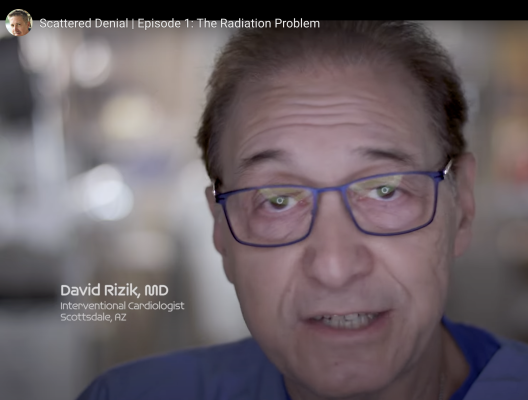
May 7, 2024 — HonorHealth Research Institute’s David G. Rizik, M.D., narrates and is a co-producer of a documentary focused on radiation and orthopedic injuries suffered by doctors and nurses who work in cardiac catheterization laboratories where they apply the very latest non-surgical technologies to treat the world’s leading cause of death, heart disease.
The premier of a two-hour, six-part version of Scattered Denial: The Occupational Dangers of Radiation will stream beginning Sunday, April 28, on www.ScatteredDenial.org, preceding a one-hour version that will air nationally in July on PBS.
“The ‘scatter’ is radiation scatter, and ‘denial’ is how we’ve denied that this was happening until it was too late,” said Dr. Rizik, research director of the Cardiovascular Research Division at HonorHealth Research Institute, the world’s leader in studies tracing the dangers of occupational radiation exposure among medical professionals, and how they can be protected by a new class of radiation shields designed specifically for their labs.
The documentary includes interviews with pioneers of interventional cardiac catheterization, in which multiple x-rays are used to navigate stents, valves, pacemakers and other devices through the vascular system and into and around the heart to restore patient health without resorting to the risks posed by open-heart surgery.
One doctor notes that the only ones exposed to more radiation than those working in catheterization labs are those working in nuclear power plants. Others talk about the injuries they’ve received from radiation exposure, including tumors up and down their heads, necks, faces, arms and legs. Most of the damage is to the left side of the body, which faces the most radiation exposure, Dr. Rizik said.
It includes footage of the internationally esteemed Edward B. Diethrich, M.D., a pioneering Phoenix cardiothoracic surgeon, who founded the Arizona Heart Institute and who died from a brain tumor in 2017: “I felt: This radiation cannot hurt me.”
Other interviews with female doctors and nurses talk about the threat radiation exposure could pose to their ability to bear healthy children.
The documentary also traces the risks doctors, nurses and other staff technicians face by repeatedly wearing 30-40-pound lead aprons, the current standard protection against radiation, which doctors say left them with ruptured disks, paralysis and other potentially career-ending orthopedic injuries.
Risks outweighed by patient benefit
Dr. Rizik said the medical professionals who began interventional cardiology 40 and 50 years ago had little thought of the potential side effects of radiation or the orthopedic risks of wearing heavy lead protection. Instead, they focused almost exclusively on their ability to provide ever-improving patient care.
“Their obsession was patient care: new and novel technologies, research and finding ways to treat patients. They didn’t think at all about radiation, and certainly didn’t think about the downstream consequences of wearing a lead apron,” he said. “We were thoroughly obsessed with being good at what we do.”
Dr. Rizik compares their zeal with that of young football players, who risk physical and cognitive injuries from constant physical impacts: “They’re only focused on scoring touchdowns and sacking quarterbacks.”
Research Institute leads the way
In March 2023, a published scientific study led by Dr. Rizik resulted in HonorHealth Research Institute becoming one of the first healthcare providers in the U.S. — and the first in Arizona — to use an advanced radiation protection system as part of the diagnosis and treatment of heart disease.
Dr. Rizik describes the new documentary as “a personal journey; a journey of discovery: What haven’t we done to protect our doctors and nurses. That’s what Scattered Denial is.”
For more information: www.honorhealth.com

 August 28, 2026