
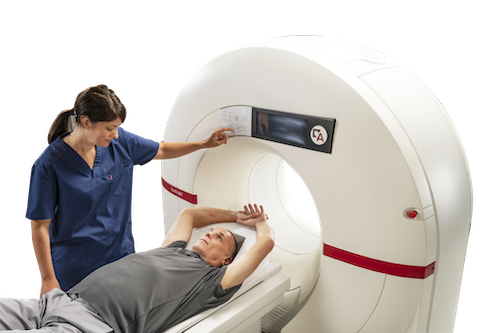
The Arineta SpotLight, a dedicated cardiovascular CT scanner, uses a lower radiation dose than whole-body CT scanners. (Photo: Arineta)
More than 1 million patients undergo a cardiac catheterization each year,1 but those numbers could decline as more cardiologists look toward coronary computed tomographic angiography (CCTA) as the first test to diagnose coronary artery disease (CAD).
In 2021, CCTA received a Class I, Level A recommendation as a frontline testing strategy in the American College of Cardiology/American Heart Association chest pain guidelines.2 Four years later, the CT-first approach to diagnosing CAD is growing in popularity, having been adopted by many major health systems nationwide.
“CCTA is an elegant way to visualize both the presence and absence of coronary atherosclerosis, as well as the overall extent and burden of disease,” says Jonathon Leipsic, MD, FRCPC, FSCCT, past president and past gold medalist of the Society of Cardiovascular Computed Tomography (SCCT) and a leading expert in the field.
Recently, Dr. Leipsic spoke with Diagnostic and Interventional Cardiology about the evolution of CT first and how it’s impacting providers, patients, and cath lab operations.
Rooted in Research
CT-first’s rapid adoption is backed by 15-plus years of accumulating research. “The findings from studies like SCOT-HEART3 and PROMISE4, along with real-world follow-ups, show that CT offers diagnostic certainty — does the patient have heart disease or not, and if so, how much?” Dr. Leipsic says. Additional studies, including data from the West Danish Heart Registry, link CT-first to improved outcomes.5
“In addition, technologies such as FFRCT [Fractional Flow Reserve Derived from CT] let us assess lesion physiology and help determine whether a patient should go to the cath lab for revascularization,” Dr. Leipsic says.
While CT-first may reduce diagnostic catheterizations, it’s best suited for patients with chest pain and no known CAD. Functional tests such as stress echocardiograms and nuclear imaging remain vital for patients with known CAD, prior stents, or bypass grafts who have recurrent symptoms.
Planning PCI With CCTA
CT already plays a critical role in helping interventionists plan endovascular aneurysm repair (EVAR) and transcatheter aortic valve replacement (TAVR) procedures. Now, advances in CCTA technology are enabling a similar level of planning for percutaneous coronary intervention (PCI) procedures.
“New visualization software allows CT data to be displayed in a way that feels familiar to interventionists, showing lesion length, fluoroscopic angles, calcium extent, and landing zones,” Dr. Leipsic says.
The Precise Procedural and PCI Plan (P4), a large, randomized trial, is currently testing the clinical utility of CT-based PCI planning.6 Dr. Leipsic and Yader Sandoval, MD, FSCAI, unveiled a comprehensive framework for using CCTA to guide PCI at the Society for Cardiovascular Angiography and Interventions (SCAI) 2025 Scientific Sessions in Washington, D.C., in May.
Overcoming the Barriers
Given the depth of research and technological advances, Dr. Leipsic predicts that CT-first will become the standard of care within a decade or even sooner. Yet access and expertise remain barriers to widespread adoption.
While reimbursement has improved, some hospitals lack trained cardiac imagers or must share scanners between radiology and cardiology, limiting throughput. “We also need broader education and awareness, especially around the complementary roles of CT and functional testing,” Dr. Leipsic says.
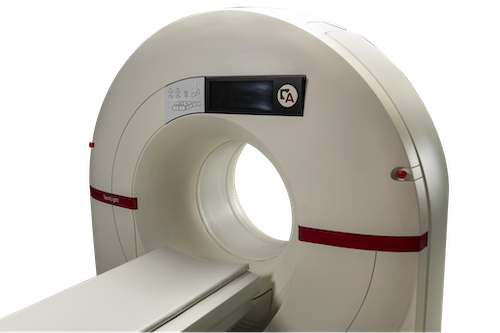
The most significant roadblock, however, is a shortage of dedicated CT scanners, especially in rural hospitals. The advent of small-footprint and mobile CCTA scanners could help close the gap, Dr. Leipsic says. His radiology team at St. Paul’s Hospital in Vancouver, British Columbia, reports strong results using such a device, the Arineta SpotLight.
“We’re performing more cases than ever before because we installed a high-quality, state-of-the-art system at low cost in a small location,” he says. “For community hospitals or regions where patients have to travel long distances, these compact or even mobile devices could be game changers. They improve efficiency and allow sites to scale their programs without building massive imaging suites.”
References
- Maqsood MH, Khalid N. Coronary CT Angiography. In: StatPearls [Internet]. Treasure Island (FL): StatPearls Publishing; 2025 Jan–. Available from: www.ncbi.nlm.nih.gov/books/NBK531461/
- Society of Cardiovascular Computed Tomography (SCCT). CCTA Receives Multiple Class 1, Level A Recommendations in 2021 New Chest Pain Guideline. Published Oct. 28, 2021. Accessed Nov. 11, 2025. https://scct.org/news/585062/CCTA-receives-Multiple-Class-1-Level-A-recommendations-in-2021-New-Chest-Pain-Guideline-.htm
- Adamson PD, Newby DE. The SCOT-HEART Trial. What we observed and what we learned. J Cardiovasc Comput Tomogr. 2019;13(3):54-58. doi:10.1016/j.jcct.2019.01.006
- van der Wall EE. The PROMISE study: a clear promise for functional stress testing in patients with suspected coronary artery disease. Neth Heart J. 2015;23(6):297-298. doi:10.1007/s12471-015-0689-2
- Kalisz K, Sandoval Y, Leipsic J, et al. Computed tomography–guided percutaneous coronary intervention planning: design and rationale of the P4 randomized trial. JACC Adv. 2025;4(3):100503. doi:10.1016/j.jacadv.2025.100503
- ClinicalTrials.gov. Planning PCI With Pre-Procedural CT (P4) Trial. Identifier NCT05253677. Updated Aug. 20, 2024. Accessed Oct. 20, 2025. clinicaltrials.gov/study/NCT05253677
