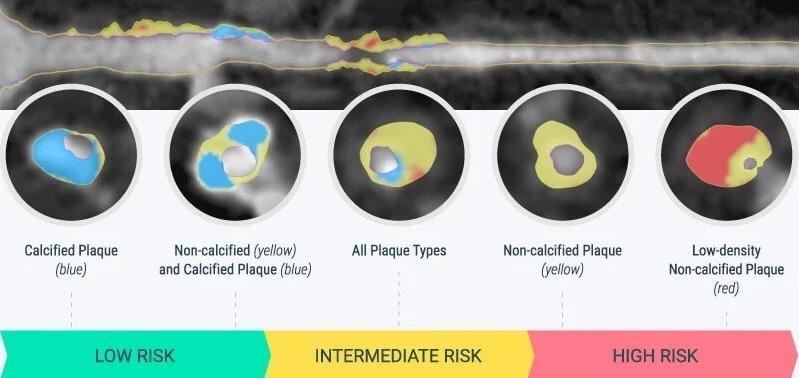
Plaques that look different, behave different. Cleerly software can quantify atherosclerosis by measuring plaque volume, composition, length and location, evaluates stenosis severity in both 2D and 3D, with a workflow for determining the likely presence or absence of ischemia, potentially reducing the need for additional testing and enhancing diagnostic confidence.
Sponsored Content — According to the American Heart Association, cardiovascular disease is the leading cause of death in the United States. In fact, the AHA reports more than 930,000 people died of coronary heart diseasein 20211.
Historically, cardiologists have addressed coronary heart disease as a very symptom-driven process. Many healthcare providers have relied on blood tests, non-invasive diagnostic tests such as coronary calcium scoring and stress testing, and family history. But over the years, it has become apparent that many people who either suffer or die from a heart attack, may not experience any premonitory symptoms before the catastrophic event.
Cardiology is shifting from addressing disease symptoms to focusing on “disease-based care,” emphasizing the importance of targeting the primary disease, atherosclerosis. Artificial intelligence (AI) is assisting this effort by quantifying and assessing coronary artery disease (CAD) to deliver clinically actionable insights through a web-based solution.
The coronary computed tomography angiography (CCTA) has been around for more than 20 years. This non-invasive tool allows clinicians to directly visualize, quantify and characterize the atherosclerosis that is silently building up in an individual’s arteries.
Today, AI-enabled analysis of CCTAs is helping to redefine coronary artery disease risk assessment and empowering clinicians to move beyond traditional surrogate markers.
The Future of Coronary Artery Disease
Atherosclerosis is the buildup of plaque in the arteries, often silently over many decades. This plaque buildup is the cause of major cardiovascular events such as heart attacks and sudden coronary death.
“Traditionally, we assessed risk with total cholesterol and other algorithms … and then tried to predict when someone would have a heart attack,” says Arthur Agatston, MD, FACC, CEO of the Agatston Center for Preventative Medicine and developer of the Agatston Coronary Calcium Score.
Those methods don’t always provide a complete picture of the patient’s situation. Agatston says you have to look at the formation of plaque and its evolution to understand what is really going on with the patient.
Cleerly, based in Denver, Colorado, offers an AI-enabled CCTA solution to address this challenge. The AI-driven platform provides comprehensive, accurate and trackable information to personalize heart attack prevention.
“The exciting thing about AI is we are able to do plaque dating a lot like carbon dating, but we are dating the actual plaque like we were doing with the age of fossil,” says Agatston. “So, if we're looking at Cleerly, [you see] a natural history of a very fatty plaque, how it becomes fibrosis scarred and then begins to calcify over years. This shows the natural history and how we can date individual plaques.”
A Clear View
The Cleerly software can quantify atherosclerosis by measuring plaque volume, composition, length and location, evaluates stenosis severity in both 2D (diameter and area) and 3D (lumen and vessel volume), with a workflow for determining the likely presence or absence of ischemia, potentially reducing the need for additional testing and enhancing diagnostic confidence.
Cleerly uses proprietary and FDA-cleared machine learning algorithms to non-invasively measure plaque, stenosis and the likelihood of ischemia using CCTA studies.
Cleerly’s analysis generates a 3D model of the patient’s arteries to reveal the different types of plaque (hardened, non-hardened and high-risk soft) that are present. The scan will also show the total plaque volume in the artery walls.

The scan can help pinpoint stenosis (narrowing) in the arteries that could lead to the risk of a heart attack. It will also identify the likelihood of Ischemia (reduced blood flow) caused by plaque buildup.
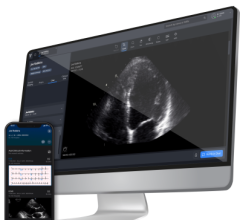
The Cleerly platform presents quantitative measurements in a comprehensive report to help healthcare providers in their diagnosis and personalized treatment. Physicians can also review results in depth using Cleerly’s interactive web platform.
Cleerly’s analyses is based on more than 10 million images from more than 40,000 patients over a 15-year period in multi-center clinical trials.
The reports provide specific data, such as detailed information on each lesion. The information in the reports also helps reduce the need for follow-ups with consulting physicians and provides a visual reference to help understand treatment options and behavior change.
Intelligent Accuracy
Dr. Joel Kahn, MD, FACC, founder of the Kahn Center for Cardiac Longevity, says one of the biggest challenges facing clinicians is that the visual assessment of coronary angiography can be invasive, expensive and not tell the whole story of the patient’s atherosclerosis. But by using coronary CT angiography with artificial intelligence plaque analysis “we can finally measure plaque … and really give accurate assessments to patients and basically non-invasively.”
Kahn says this provides incremental prognostic information over other methods of assessing coronary CT angiogram. The CT angiogram with AI was superior in predicting prognosis to the coronary artery calcium score and other measurements “and significantly improved risk stratification compared to the other methods,” Kahn says.
Cleerly uses machine learning trained on millions of patient images to detect plaque AND also quantify plaque type, volume and location. This provides a comprehensive view of hardened and soft plaque blockages and the potential for reduced blood flow. The early detection of plaque can provide clinicians with the information they need to prescribe proactive measures to prevent the possibility of heart attacks.
“We have precision cardiology. We have precision medicine. The future is bright!” Kahn says. “We just need to use it more widely, apply it and see improved outcomes because this beast, the number one killer of men and women in the western world, needs to end.”
Dr. Agatston and Dr. Kahn recently presented a webinar on “The Next Level of Clarity: Why CAD Risk Needs More Than Surrogate Markers.” In the webinar, Agatston and Kahn, along with Cleerly CEO Jim Min, MD, explore how AI-enabled CCTA with plaque analysis is redefining CAD risk assessment and empowering clinicians to move beyond surrogate markers. Drs Kahn and Agatson present real-world case studies showing how they have used the technology in their practices to personalize patient care and help prevent future cardiac events.
The webinar can be accessed at cleerlyhealth.com/CADclarity.
To learn more about Cleerly Health and its products and services, go to www.cleerlyhealth.com.
 September 09, 2026