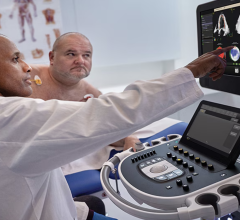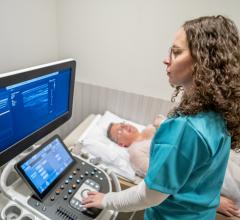
June 13, 2016 — Two new research studies verify that echocardiography, linked to experts through telemedicine, can provide better and more economical clinical healthcare to patients living a great distance from a cardiac care center. One study focused on a statewide fetal cardiac telemedicine program, while the other evaluated the feasibility of training parents to acquire basic echo images in pediatric heart transplant patients.
Both studies were presented during the 27th Annual American Society of Echocardiography (ASE) Scientific Sessions, June 10-14 in Seattle.
Researchers at The Heart Center at Arkansas Children’s Hospital, the only congenital cardiac center in Arkansas, also serving regions in multiple bordering states, sought to determine the effectiveness of telemedicine fetal echocardiography as a screening tool. Lead author, Elijah Bolin, M.D., University of Arkansas for Medical Sciences, Little Rock, Ark., said, “The prenatal diagnosis of heart disease in the fetus can directly impact a baby’s course of care after birth. Many expectant mothers live far away from centers that are able to perform fetal echocardiograms, the diagnostic study which allows for proper identification of fetal heart disease. Over five years, 57 fetuses were diagnosed with heart disease and four had critical congenital malformations requiring immediate medical intervention in the postnatal period. Telemedicine can aid underserved expectant mothers by both accurately identifying those fetuses with heart disease, and by otherwise reassuring mothers whose fetus has a normal heart.”
Researchers on the study, Reaching High-risk and Underserved Mothers: Fetal Cardiac Evaluation by Telemedicine is an Effective Screening Tool, include Bolin, Ronnie T. Collins II, Sean M. Lang, Dala Zakaria, Thomas H. Best and Renee A. Bornemeier from the University of Arkansas for Medical Sciences, Little Rock.
Pediatric heart transplant patients are at high risk for graft rejection with rapid deterioration of heart function. Prompt detection of rejection can reduce morbidity and mortality. In the second study, a team of researchers at Lucile Packard Children’s Hospital Stanford evaluated if parents of these patients can learn how to acquire basic echo images using a handheld device.
“More than half of our pediatric heart transplant patients live more than 100 miles away from our center,” noted lead author Seda Tierney, M.D., of the Stanford University School of Medicine. “These patients are frequently seen in emergency rooms for a variety of symptoms that might be due to rejection. Often, an echo is requested by the care team to ensure that the heart function is normal. Unfortunately, often an echo cannot be performed in these emergency rooms around the clock. Furthermore, a large number of these symptoms end up not being due to graft rejection. Our team is very excited to show that we can successfully train parents of pediatric heart transplant patients in basic echo imaging skills with a small portable echo device they can take home. The images can be sent to the care team via the Internet for evaluation. This will be a novel tool for families and caregivers allowing better remote assessment of these children at risk for transplant rejection in the comfort of their home, and will likely decrease the frequency of emergency room visits long term.”
Researchers on the study, Parental Acquisition of Echocardiographic Images in Pediatric Heart Transplant Recipients: A New Era?, include Tierney, Alaina K. Kipps, Katherine M. Stefani, Nancy McDonald, Donna Lee, Lynsey Barkoff and David Rosenthal from the Stanford University School of Medicine.
For more information: www.asescientificsessions.org
 July 27, 2026