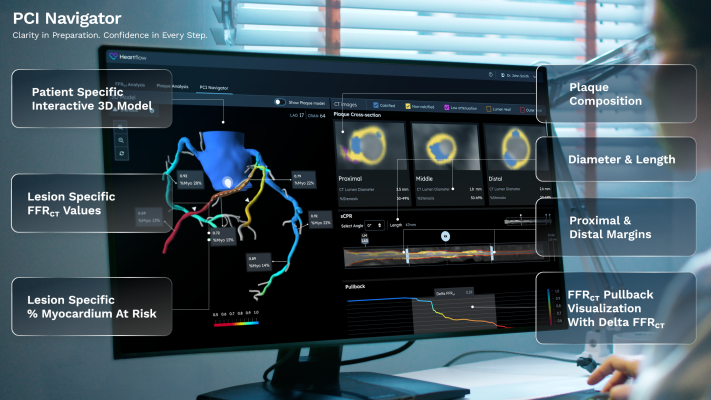
Heartflow PCI Navigator (Photo: Heartflow Inc.)
Oct. 22, 2025 — Heartflow, Inc. has introduced Heartflow PCI Navigator, the newest addition to the Heartflow One platform. PCI Navigator is an integrated, AI-driven percutaneous coronary interventions (PCI) planning tool that gives interventional cardiologists a patient-specific 3D model — detailing anatomy, plaque composition, and lesion-specific physiology — all aligned to optimize potential stent placement. For the first time, interventional cardiologists can plan PCIs with relevant information brought together in one intuitive view before their patients are in the cath lab.
Heartflow will showcase PCI Navigator with live demonstrations at the Transcatheter Cardiovascular Therapeutics (TCT) conference, in San Francisco.
PCI Navigator delivers a streamlined view of essential information for cath lab decision-making by integrating all relevant measurements, including IVUS-like and FFR-like pullback visualizations, into one seamless experience, which typically requires significant time and effort to obtain in the cath lab.
“Interventional cardiologists make some of the most critical decisions in coronary care, often with limited information before a case begins. CT-guided PCI addresses that information gap, harnessing insights from the CCTA pathway into a pre-procedural plan to provide physicians the clarity they need for each case. PCI Navigator puts Heartflow at the forefront of that shift,” said Campbell Rogers, M.D., F.A.C.C., Chief Medical Officer of Heartflow. “CCTA with Heartflow analysis helps ensure that all patients warranting invasive management are directed to the cath lab, while also reducing invasive angiograms and improving efficiency. PCI Navigator enhances planning for these patients by integrating anatomy, plaque, and lesion-specific physiology for the interventionalist’s review and input before the procedure.”
PCI Navigator will deliver a streamlined view of essential information for cath lab decision-making including:
- Procedural Complexity: Lesion-specific FFRCT values, stenosis, plaque location and composition, as well as percent myocardium fed by a vessel, to help understand lesion significance in context.
- Stent Landing Zones: Cross-sectional and longitudinal reconstructions providing lumen diameter and length measures alongside plaque morphology and stenosis severity to help precisely plan and guide procedures.
- Planning for Optimal Outcomes: Physiology changes along the lesion (ΔFFRCT) to ensure the stenting procedure addresses the maximal flow gradient for optimal outcomes.
By bringing together information that interventional cardiologists need to plan procedures into a web-based interface, PCI Navigator may help streamline procedures with increased efficiency and clinical confidence for both patients and staff.
Additional information is available at heartflow.com.

 August 31, 2026