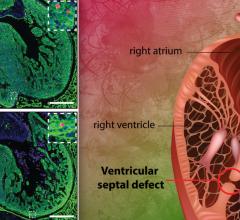
July 31, 2015 — The American Society of Echocardiography (ASE) released a new document describing various imaging strategies for diagnosing a “hole in the heart,” one of the most common types of congenital heart defects. The document, Guidelines for the Echocardiographic Assessment of Atrial Septal Defect and Patent Foramen Ovale: From the American Society of Echocardiography and Society for Cardiac Angiography and Interventions, describes the various defects, the modalities used to evaluate them, and clearly lays out strategies for optimal imaging.
Nearly one in four adults have one type of such defect called a patent foramen ovale (PFO), a small hole between chambers which does not close fully after birth. In many cases, PFOs and other types of atrial septal defects (ASDs) are small and may not cause symptoms for years, if ever. But when these defects are larger, they may cause problems and often need to be repaired, either in childhood or adulthood.
In such cases, echocardiographic imaging is essential to make the diagnosis, determine the severity of the defect, determine the need for intervention, and in many cases guide the intervention as it is performed.
The writing group for the ASE guideline was chaired by Frank E. Silvestry, M.D., FASE, associate professor of medicine, and director of the cardiovascular disease fellowship at the University of Pennsylvania, in Philadelphia. Silvestry noted, “This collaboration between the ASE and SCAI represents a tremendous step forward in defining and standardizing the echocardiographic imaging of patients with atrial septal abnormalities. It represents a unique collaborative effort between adult and pediatric cardiologists, including both imagers and interventionalists, and will serve as a tremendous resource for all interested in this area.”
The paper describes the different types of atrial septal abnormalities in detail, and also fully outlines the advantages and disadvantages for each type of echocardiography that may be employed: transthoracic echo (TTE), transesophageal echo (TEE), three-dimensional echo (3DE), intracardiac echo (ICE), Doppler echo and transcranial Doppler (TCD). The document contains more than 50 figures, 10 tables and 28 videos, which include imaging protocols, strategies for overall evaluation, and recommendations for guidance and follow-up imaging after various interventions.
The paper will appear in the August 2015 issue of the Journal of the American Society of Echocardiography (JASE).
In conjunction with the publication of the guideline document, Silvestry will conduct a live webinar, including a question and answer section, on Sept. 30, 2015 at 5:00 pm ET.
For more information: www.asecho.org

 March 31, 2025