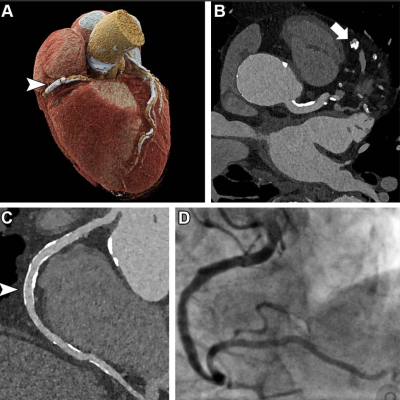
Ultrahigh-resolution (UHR) coronary CT angiography (CCTA) in an 85-year-old man before transcatheter aortic valve replacement. Despite a stent in the right coronary artery and very severe coronary sclerosis with an Agatston score of 4162, diagnostic visualization of the coronary arteries succeeded, and obstructive coronary artery disease was excluded on CT images. (A) Three-dimensional cinematic rendering of the heart. The stent (arrowhead) is visible in the middle segment of the right coronary artery. (B) UHR CCTA with 0.2-mm axial sections. The lumen (arrow) of the severely calcified distal left anterior descending artery can be assessed without artifacts. (C) Curved multiplanar reformations of the right coronary artery with a diagnostic display of the stent lumen (arrowhead). (D) Invasive coronary angiography enables exclusion of in-stent stenosis. Image courtesy of RSNA
June 22, 2023 — New ultra-high-resolution CT technology enables excellent image quality and accurate diagnosis of coronary artery disease in high-risk patients, a potentially significant benefit for people previously ineligible for noninvasive screening, according to a study published in Radiology.
Coronary CT angiography (CCTA) is highly effective for ruling out coronary artery disease in patients at low or intermediate risk for the disease. Unfortunately, CCTA in a high-risk population is difficult due to a high prevalence of coronary calcifications and stents.
Coronary calcifications tend to “bloom” on CCTA, making them appear more extensive than they really are. This results in overestimation of blockages and plaque and false-positive results.
“Consequently, patients may undergo unnecessary, often invasive, testing,” said study lead author Muhammad T. Hagar, MD, from the Department of Diagnostic and Interventional Radiology at the University of Freiburg in Germany. “This is the reason why current guidelines do not recommend using CCTA in high-risk individuals.”
Ultra-high-resolution coronary CT angiography (UHR-CCTA) is a promising tool for the noninvasive assessment of patients at high risk for coronary artery disease. Because it uses recently introduced photon-counting CT scanners, it has not been extensively studied.
Dr. Hagar and colleagues compared the diagnostic accuracy of UHR-CCTA with that of the reference standard of invasive coronary angiography (ICA) in 68 patients. The patients had severe aortic valve stenosis.
UHR-CCTA was highly sensitive and specific for coronary artery disease detection. It delivered a median overall image quality score of 1.5 on the 5-point Likert scale. Almost 80% of segments rated as good or excellent.
For more information: www.rsna.org

 August 17, 2026