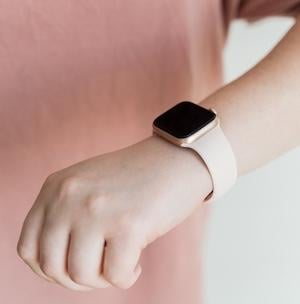
A new study found that the Apple Watch can capture arrhythmia events in children potentially more effectively than traditional ambulatory patch rhythm monitors. Photo: Getty Images
April 23, 2026 — A new study examining the accuracy of wearable technologies for capturing irregular heartbeats in children found that the Apple Watch can capture arrhythmia events potentially more effectively than traditional ambulatory patch rhythm monitors. Researchers presented these findings as an oral abstract today at Heart Rhythm 2026 in Chicago.
Arrhythmias occur when the heart beats too fast, too slow, or unevenly. These irregular heart rhythms affect millions of adults and children in the United States.1 In recent years, wearable devices have evolved from general wellness trackers into tools that can screen for heart rhythm disorders, particularly atrial fibrillation (AF). Nearly one in four Americans with cardiovascular disease now uses wearable fitness technology2, such as the Apple Watch, prompting substantial research into these devices’ ability to capture arrhythmias in adults. However, despite heart rhythm disorders also being common in children3, researchers have conducted relatively few studies examining whether wearable devices can capture heart rhythm abnormalities in pediatric populations.
The Pediatric Apple Watch Study (PAWS) included 107 children and adolescents aged 6-18 years (average age 14; 62% female) undergoing outpatient evaluation for heart palpitations using an ambulatory patch rhythm monitor. Participants also received an Apple Watch (Version 5 or later). Over a six-month period, participants used their watch to record an electrocardiogram (ECG), a measurement of the heart’s electrical activity, whenever they experienced arrhythmia symptoms. The device automatically transmitted recordings to a secure digital platform. Electrophysiologists reviewed the ECG tracings, device- generated diagnoses, and tracing quality, and compared arrhythmia events captured by the Apple Watch\ with those recorded by the patch monitor.
The study found that 79% of Apple Watch ECG tracings recorded during episodes of tachyarrhythmia — when the heart beats faster than normal — were rated good or excellent in quality, meaning specialists could reliably interpret them. The device’s algorithm correctly identified AF in 73% of ECGs and correctly flagged supraventricular tachycardia (SVT) as “high heart rate” in 75% of cases. Overall, the Apple Watch captured arrhythmia events in twice as many patients than captured by the monitor.
“Most research on wearable devices for arrhythmia characterization has focused on adults, leaving an important gap in pediatric care,” said Scott Ceresnak, MD, Professor of Pediatrics at Stanford University School of Medicine. “Our study is among the first to evaluate how devices like the Apple Watch perform in children. The findings suggest wearable technologies could help transform how we test for, capture, and ultimately manage heart rhythm abnormalities in younger patients.”
These findings demonstrate the potential for consumer wearable devices, such as the Apple Watch, to help capture arrhythmias in children, and to complement traditional cardiac monitoring methods. .
Because many patients already own wearable devices, clinicians may be able to review ECG data collected outside clinical settings, potentially expanding access to heart rhythm monitoring. However, researchers note that clinicians should interpret consumer wearable device data within a clinical context, particularly given ongoing challenges with diagnostic specificity. As consumer devices continue to offer more health-related features, it’s likely that they will play an increasingly relevant role in medical care.
Future studies should evaluate wearable-based monitoring in larger pediatric populations and across diverse clinical settings.
The HRS Session is titled, “Digital Health and Innovation: The Pediatric Apple Watch Study (PAWS): A Prospective Assessment of Wearables for Arrhythmia Detection in Children.”
-
i Dhingra LS, Aminorroaya A, Oikonomou EK, Nargesi AA, Wilson FP, Krumholz HM, Khera R. Use of wearable devices in individuals with or at risk for cardiovascular disease in the US, 2019 to 2020. JAMA Network Open. 2023; 6(6): e2316634.
-
ii Noubiap, J, Tang, J, Teraoka, J. et al. Minimum National Prevalence of Diagnosed Atrial Fibrillation Inferred From California Acute Care Facilities. JACC. 2024 Oct, 84 (16) 1501–1508. https://doi.org/10.1016/j.jacc.2024.07.014
-
Iii Russ Adwan, Shannon Thatcher, Sarah Russo, Svjetlana Tisma-Dupanovic, Arrhythmias in children: Too fast or too slow, Progress in Pediatric Cardiology, Volume 65, 2022, 101520, ISSN 1058-9813, https://doi.org/10.1016/j.ppedcard.2022.101520.
 April 24, 2026