Getty Images
January 23, 2024 — Sequana Medical NV, a pioneer in the treatment of fluid overload in liver disease, heart failure and cancer, announced that an independent Data and Safety Monitoring Board (DSMB) approved the start of the randomized cohort in MOJAVE, the US Phase 1/2a study of DSR 2.0 for treatment of patients with diuretic-resistant heart failure, following review of the safety data reported from the non-randomized cohort.
Follow-up data from the three patients in the non-randomized cohort confirm the durable improvement in their cardio-renal health and support DSR’s mechanism of action as breaking the vicious cycle of cardiorenal syndrome.
The randomized controlled cohort will enroll up to 30 additional patients across different centers in the US, with up to 20 patients treated with DSR 2.0 on top of optimized usual care for congestive heart failure for up to four weeks, and up to ten control patients treated with intravenous loop diuretics as part of maximized usual care for congestive heart failure. After the last DSR treatment, patients will be followed for a three-month safety follow-up period. The first patient is expected to be enrolled in Q1 2024 and interim data are planned for H2 2024.
Dr. Oliver Gödje, Chief Medical Officer of Sequana Medical, commented: “We are delighted to announce the ongoing progress of our US MOJAVE study and look forward to enroll the first patient in the randomized cohort later this quarter. Building upon the strong data reported from the non-randomized MOJAVE cohort and our previous RED DESERT and SAHARA studies, we are confident about the clinical effectiveness of our DSR therapy compared to loop diuretics. We look forward to reporting interim data from the MOJAVE randomized cohort in the second half of this year to further demonstrate the potential of DSR as a disease-modifying heart failure drug therapy tackling cardiorenal syndrome.”
Positive data from non-randomized cohort of MOJAVE study
Data from the four-week DSR treatment period, as reported previouslyii:
All three patients treated in the non-randomized cohort of the MOJAVE study had heart failure with preserved ejection fraction (HFpEF) and severe diuretic resistance at baseline (mean furosemide equivalent dose of 1,227 mg per day). At the start of the study treatment period, loop diuretics were withheld, and patients were treated with DSR 2.0 up to daily for four weeks, followed by a three-month safety follow-up period.
Dramatic improvement in diuretic response and renal status: During the four-week DSR treatment period, all three patients maintained euvolemia without the need of loop diuretics. Their diuretic responseiii nearly normalized with a mean increase of 324% in their six-hour urinary sodium excretion post-treatment vs baseline. There was a broad improvement in their kidney function with a a mean improvement in eGFRiv of 47% and blood urea nitrogenv of 57% post-treatment vs baseline.
Updated data from the three-month safety follow-up period:
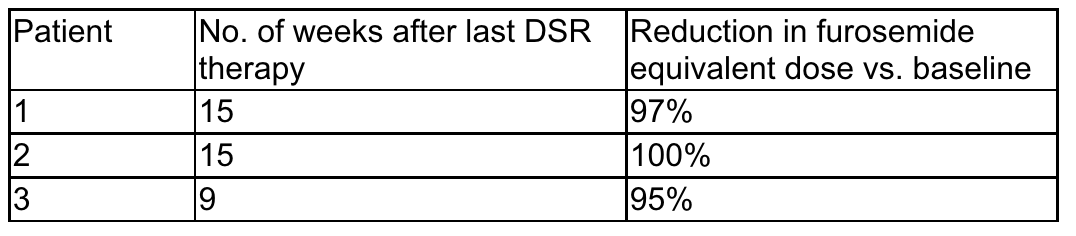
Loop diuretics virtually eliminated vs. baseline: Two patients have completed the three-month safety follow-up period and one patient is still in the follow-up period. The need for loop diuretics was dramatically reduced or even completely eliminated up to 15 weeks after the four-week DSR treatment period (see table below).
Improvement in renal parameters maintained: At the end of the three-month safety follow-up period, the diuretic response of the two patients who already completed the study remained normalized, with a similar high output in their six-hour urinary sodium excretion as compared to their dramatically improved diuretic response after the four-week DSR treatment period. Their kidney function also remained stable as measured by their improvement in eGFR and blood urea nitrogen.
To date, no clinically relevant changes in serum sodium levels or progressive hyponatremia were observed and none of the patients needed to be hospitalized for congestion since the start of the study. Until today, there was only one serious adverse event of short-term hypertension at 12 weeks after the last DSR therapy, which was adjudicated as non-related to DSR therapy. Short-term hypertension is often seen in this very sick patient population. These data indicate that DSR 2.0 is safe and well tolerated as confirmed by the DSMB.
For more information: www.sequanamedical.com
References:
i DSMB: Data Safety Monitoring Board
ii See press release of 29 November 2023
iii Diuretic response assessed by 6-hour excretion of sodium after IV administration of 40mg furosemide
 September 02, 2026