July 20, 2022 — Sequana Medical NV, a pioneer in the treatment of drug-resistant fluid overload in liver disease and heart failure, announced the completion of enrollment in its Phase 2a SAHARA proof-of-concept study using its first-generation DSR product (“DSR 1.0”) as treatment for congestive heart failure. Sequana Medical intends to extend SAHARA to treat a small number of patients with its proprietary second-generation DSR product (“DSR 2.0”) to support the US IND filing, expected by year end.
The Company has conducted two proof-of-concept studies, the RED DESERT study in euvolemic heart failure patients and the SAHARA study in decompensated heart failure patients, demonstrating that intensive DSR therapy with DSR 1.0 delivers compelling and durable clinical improvements in diuretic-resistant heart failure patients, including safe, rapid and effective decongestion, dramatic improvement in cardio-renal status and restoration of diuretic responsiveness. As a result of the strong, durable clinical signals observed, the Company will focus the heart failure development program on Short Term DSR with its proprietary DSR 2.0 administered with a peritoneal catheter.
Ian Crosbie, Chief Executive Officer of Sequana Medical, said: “We are very encouraged by the results from our DSR program and consider Short Term DSR to be a disease-modifying drug therapy for this large and very difficult-to-treat patient population. Based on what we have learned from RED DESERT and SAHARA, we will focus on Short Term DSR using our proprietary DSR 2.0. With just three to four weeks of DSR treatment, we believe that we can bring patients important clinical benefits lasting up to a year and progress this potential breakthrough therapy to patients in need as efficiently as possible.”
Dr. Oliver Gödje, Chief Medical Officer at Sequana Medical, added: “We and our advisors are very impressed by the results and see DSR therapy as a treatment for heart failure that is complementary to other therapies. As cardiologists, we struggle to remove congestion from patients with diuretic resistance, which is the primary driver of morbidity and hospitalization in heart failure. DSR therapy tackles the key clinical need of sodium overload in patients in whom loop diuretics are no longer effective. The patients treated with DSR therapy in our studies have not been re-hospitalized for congestion-related heart failure problems during their study follow-up period and the clinical outcomes resulted in a substantial increase in predicted survival using the Seattle Heart Failure Model. We are now preparing for a US IND filing of our DSR 2.0 by year end to start MOJAVE, our Phase 1b/2a US study.”
DSR Heart Failure Drug Development
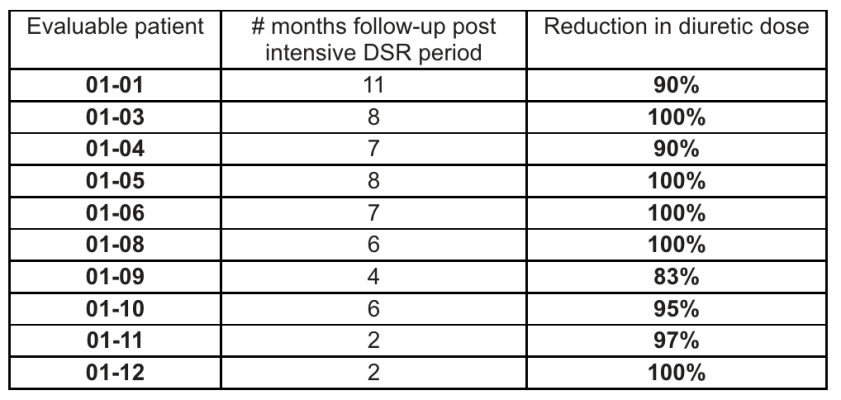
Twelve decompensated diuretic-resistant heart failure patients have been enrolled in the SAHARA study using DSR 1.0. Interim results from ten evaluableiv patients after completion of the intensive DSR period demonstrated that DSR therapy safely, effectively and rapidly eliminated persistent congestion and restored euvolemia (i.e., normal amount of body fluids), resulting in a mean weight loss of 6kg. There was a near normalization of diuretic response with six-hour excretion of sodium more than doubling vs. baseline, as well as a considerable improvement in cardio-renal health, with a mean reduction in NT-proBNP, a key cardiac function parameter, of more than 30% vs. baseline and a stable renal function (eGFRv) vs. baseline despite this dramatic fluid loss. The need for loop diuretics was dramatically reduced for many months following completion of the intensive DSR therapy (see table below), which the Company believes is an important demonstration of the improvement in cardio-renal health of these patients.
Additionally, patients treated with DSR therapy in both RED DESERT and SAHARA experienced no congestion-related heart failure hospital re-admissions during their follow-up period in the study. The clinical benefits observed in RED DESERT and SAHARA result in a 75% reduction in predicted one-year mortality of patients pre- vs. post-intensive DSR therapy based on the Seattle Heart Failure Model.
Based on the SAHARA observations, which reinforce those observed in the RED DESERT study, the Company believes that an intensive treatment period of three to four weeks of DSR therapy is sufficient for six to twelve months of important clinical benefits. Therefore the Company is focusing its DSR development program on Short Term DSR using its proprietary DSR 2.0 that is expected to have an improved therapeutic and favorable safety profile, administered via a peritoneal catheter. In addition, the Company believes that given Short Term DSR will be regulated as a drug only (rather than a drug-device combination for Long Term alfapump DSR), this will shorten and de-risk the clinical and regulatory paths, and therefore the time to market.
To support the US IND filing of DSR 2.0, the Company intends to extend SAHARA to treat a small number of patients with DSR 2.0. Patients with diuretic-resistant congestive heart failure on high doses of loop diuretics will undergo intensive DSR therapy with DSR 2.0 for two weeks which can be repeated up to two times depending on their euvolemic state, diuretic response and stable DSR dosing. Primary endpoints include safety and tolerability of DSR 2.0 and secondary feasibility endpoints include the ability of DSR therapy to restore and maintain euvolemia without the need for additional loop diuretic treatment. Top-line results of SAHARA, using DSR 1.0 and 2.0, and the US IND filing of DSR 2.0 are expected by year end.
To support a compelling package for partnering, the Company is expanding its planned MOJAVE US Phase 1b/2a study. This randomized controlled study in approximately 30 diuretic resistant chronic heart failure patients will evaluate Short Term DSR with DSR 2.0 administered via a peritoneal catheter on top of standard-of-care therapy vs. standard-of-care therapy alone. This study will commence following submission and approval of the US IND.
For more information: www.sequanamedical.com
 September 02, 2026