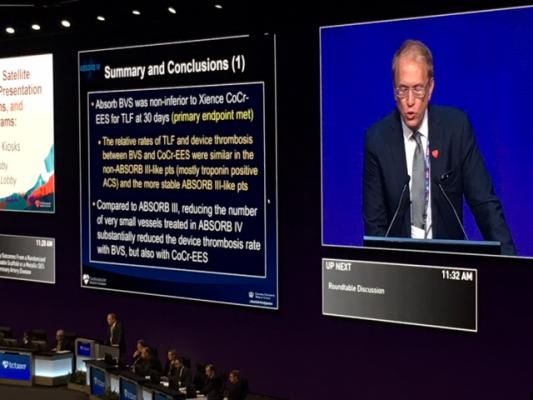
October 31, 2017 – Thirty-day results from ABSORB IV, the largest randomized everolimus-eluting bioresorbable vascular scaffold (BVS) trial to date, found BVS to be noninferior to a cobalt-chromium everolimus-eluting stent (CoCr-EES) for target lesion failure (TLF).
Findings were reported at the 29th annual Transcatheter Cardiovascular Therapeutics (TCT) scientific symposium, Oct. 29-Nov. 2 in Denver, sponsored by the Cardiovascular Research Foundation (CRF).
First-generation BVS have been associated with higher rates of TLF and device thrombosis than current metallic drug-eluting stents. It has been thought that this may be in part due to suboptimal implantation technique used in early studies. Therefore, the ABSORB IV trial mandated the avoidance of smaller vessels, and aggressive pre-dilatation and routine high-pressure post-dilatation were emphasized.
ABSORB IV also permitted the enrollment of more complex and higher-risk patients than ABSORB III, with inclusion of troponin-positive acute coronary syndrome (ACS) and up to three lesions in a maximum of two epicardial coronary arteries, including thrombus. Patients were randomized 1:1 to BVS or CoCr-EES after successful pre-dilatation with a 1:1 sized balloon.
Between Aug. 15, 2014 and March 31, 2017, 2,604 patients at 140 sites in five countries were randomized to BVS (N=1,296) versus CoCr-EES (N=1,308). Median age was 63 years; 28 percent of patients were female and 31.7 percent had diabetes. Among patients receiving BVS, pre-dilatation was performed in 99.8 percent of lesions, and post-dilatation was performed in 82.6 percent of lesions. The acute device success (delivery and deployment of the study scaffold/stent with residual stenosis <30 percent) was 94.6 percent for BVS compared to 99 percent for CoCr-EES (P<0.0001).
The primary endpoint of 30-day target lesion failure (TLF) was 5 percent for BVS versus 3.7 percent for CoCr-EES, a difference of 1.29 percent (Pnoninferiority=0.02; Psuperiority =0.11). As treated 30-day TLF was 4.6 percent for BVS versus 3.7 percent for CoCr-EES, a difference of 0.83 percent (Pnoninferiority=0.006). Patient-oriented major adverse cardiac events (PoCE) were 5.2 percent for BVS compared to 4.1 percent for CoCr-EES (P=0.17). However, the rate of 30-day ischemia-driven target vessel revascularization (ID-TLR) was 1.2 percent versus 0.2 percent (P=0.003), and the rate of device thrombosis was 0.6 percent in the BVS group and 0.2 percent in the CoCr-EES group (P=0.06).
“At 30 days, BVS was non-inferior to CoCr-EES for target lesion failure,” said Gregg W. Stone, M.D., professor of medicine at Columbia University Medical Center, and director of cardiovascular research and education at the Center for Interventional Vascular Therapy at NewYork-Presbyterian Hospital. “The rates of non-peri-procedural MI [myocardial infarction] and ID-TLR at 30 days were greater with BVS than with CoCr-EES, and a trend toward greater stent thrombosis with BVS was present. Compared to ABSORB III, reducing the number of very small vessels treated in ABSORB IV substantially reduced the device thrombosis rate in both groups. These results are largely consistent with those from earlier ABSORB trials, and highlight the need for continued advancements in device technology and standardized technique to further improve the early safety profile of BVS.”
The ABSORB IV trial was funded by Abbott Vascular. Stone reported that he is chairman of the ABSORB global clinical trial program (uncompensated) and a consultant to Reva Inc.
For more information: www.tctconference.com
Related Absorb BVS Content
FDA Investigating Increased Major Adverse Cardiac Event Rates of Absorb Bioresorbable Stent

 August 28, 2026