
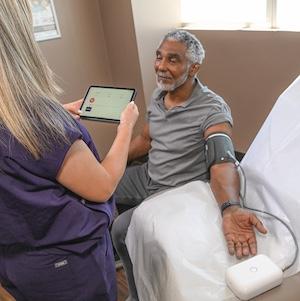
Ventric Health’s Vivio System identifies early-stage heart failure at the point of care in under five minutes, streamlining the transition to Stellus Rx’s specialized pharmacy care management. (Photo: Ventric Health)
Nov. 12, 2026 — Ventric Health and Stellus Rx have announced a strategic collaboration designed to solve one of primary care and population health's most persistent clinical challenges: transitioning patients rapidly from early heart failure (HF) detection to fully optimized, long-term medication management.
By aligning Ventric Health's point-of-care diagnostic technology, the Vivio System, with Stellus Rx's specialized pharmacy care management, the two companies are establishing a continuous clinical care pathway that connects rapid outpatient diagnosis directly to full-pillar Guideline-Directed Medical Therapy (GDMT) optimization.
Closing the Diagnostic-to-Treatment Gap
While catching heart failure early in the outpatient setting is critical to preventing high-cost acute events, particularly among high-risk patients with conditions such as hypertension, type 2 diabetes, or chronic kidney disease, initiating and managing standard-of-care four-pillar GDMT (comprising ARNIs, beta-blockers, MRAs and SGLT2 inhibitors) is notoriously complex and resource-intensive for primary care providers (PCPs). Achieving target therapeutic doses requires biweekly dose titrations, routine laboratory monitoring, prior authorization management and intensive patient education. As a result, many patients with early-stage heart failure remain un-optimized or under-dosed, leading to preventable disease progression, emergency department visits and acute hospitalizations.
"Identifying heart failure early at the point of care is a critical first step, but the true value of diagnosis is only realized when it leads immediately to optimized, guideline-directed treatment," said Thomas Cheek, MD, Chief Medical Officer at Ventric Health. "By collaborating with Stellus Rx, we are giving primary care providers a complete solution, enabling them to detect elevated left ventricular end-diastolic pressure in minutes and quickly transition patients into a proven care management program that drives long-term adherence and protects patient health."
An Integrated, Team-Based Workflow
This strategic collaboration tackles administrative and clinical bottlenecks by pairing objective, rapid diagnostic data with dedicated, Electronic Health Record (EHR) embedded clinical pharmacist support:
- Point-of-Care Detection in Minutes: Ventric Health utilizes its FDA-cleared, non-invasive Vivio System to measure left ventricular end-diastolic pressure (LVEDP) in under five minutes during a standard primary care visit, identifying Stage B and Stage C heart failure well before acute symptom onset.
- Streamlined Care Transitions: Once elevated LVEDP or presymptomatic heart failure is identified, primary care teams can seamlessly connect patients to Stellus Rx's specialized virtual pharmacy care team.
- EHR-Embedded Pharmacist Workflows: Stellus Rx clinical pharmacists can integrate directly into the practice's EHR system, enabling bi-directional communication with PCPs regarding titration updates, lab results and patient progress.
- Protocol-Driven Titration and Barrier Removal: Acting as an extension of the primary care team, Stellus Rx pharmacists conduct biweekly patient touchpoints to monitor vital signs and titrate GDMT medications to target doses. They also resolve prior authorizations, work to eliminate financial barriers and provide home delivery of medications, with the option of customized compliance packaging.
"Managing the polypharmacy and frequent titrations required for heart failure therapy is a substantial operational burden for busy primary care practices," said Tony Makarich, PharmD, Chief Clinical Partner at Stellus Rx. "Our clinical pharmacists act as a seamless extension of the provider, managing the intensive clinical tracking, lab monitoring and barrier resolution required to get patients to goal. By collaborating with Ventric Health to bridge early point-of-care diagnosis with continuous pharmacotherapy, we relieve clinical and operational burden for physicians while ensuring patients receive the full mortality and morbidity benefits of GDMT."
Heart Failure Care
For health systems, Medicare Accountable Care Organizations (ACOs) and Medicare Advantage plans, optimizing GDMT early in the primary care setting dramatically improves clinical trajectories while lowering total cost of care. Research shows that comprehensive four-pillar GDMT can add over eight years free of cardiovascular death or heart failure hospitalization for a 55-year-old patient compared to conventional dual-therapy.1
"Value-based care has to be team-based care," added Dr. Patrick Goggin of the Physicians Group of Southeastern Ohio (PGSEO), a clinical group using pharmacist-supported care pathways. "We want our primary care doctors to own the continuum of heart failure management. Working alongside clinical pharmacists allows us to walk side-by-side through the guidelines with the patient. It supports our doctors with a comprehensive set of resources and ensures high-risk patients don't fall through the cracks."
Reference:
-
Vaduganathan M, Claggett BL, Jhund PS, et al. Estimating lifetime benefits of comprehensive disease-modifying pharmacological therapies in patients with heart failure with reduced ejection fraction: a comparative analysis of three randomised controlled trials. Lancet. 2020; 396(10244):121-128. doi:10.1016/S0140-6736(20)30748-0.

 September 09, 2025