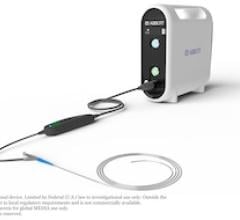
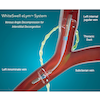
eLym System. Image: WhiteSwell
May 10, 2026 — WhiteSwell has announced primary results from the DELTA-HF feasibility clinical trial evaluating the eLym System for acute decompensated heart failure (ADHF). The data were presented at the Heart Failure 2026 Congress in Barcelona and simultaneously published in the European Journal of Heart Failure.
Data from the 40 patients treated with the eLym System demonstrated decongestion at discharge (mean weight loss of 6.8 Kg and median modified EVEREST Clinical Congestion Score of 0), stable kidney function as measured by serum creatinine and an 82.5% freedom from heart failure hospitalization and death at 6 months. The eLym System was successfully deployed in 100% of cases, with two patients experiencing serious procedure-related adverse events.
“Patients enrolled in the DELTA-HF study had multiple co-morbidities with many poor responders to the current standard of care, diuretic therapy. In diuretic non-responders, we would expect to see six-month event rates as high as 50%,” said Study Principal Investigator William T. Abraham, MD, College of Medicine Distinguished Professor at The Ohio State University. “Thus, the 82.5% freedom from heart failure hospitalization and death at six months is particularly noteworthy. I look forward to continuing clinical evaluation of this paradigm-shifting approach and its potential to more effectively decongest patients with difficult-to-treat ADHF.”
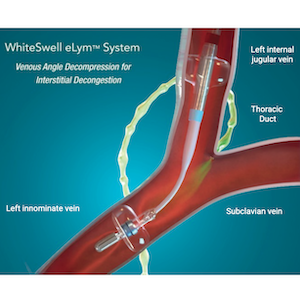
The DELTA-HF trial was a multicenter, single-arm study evaluating the safety and effectiveness of the eLym System in ADHF. The patient population enrolled in the study was hospitalized, despite high home diuretic dose, and presented with multiple comorbidities. In the study, a localized reduced-pressure zone at the venous angle was created in 40 patients using an endovenous micro-axial impeller pump to support lymph drainage through the thoracic duct. Hospitalized patients were treated with the eLym System for an average of 23.1±7.3 hours, in conjunction with standard-of-care IV diuretic therapy. Patients were followed for six months.
Summary of key findings:
- The device was deployed successfully in all 40 patients, and reduced Thoracic Duct pressure in 98% of cases
- Patients treated with the eLym System plus IV diuretic therapy lost a mean of 6.8 ± 3.4 kg by discharge
- The median modified EVEREST congestion score at baseline was 5.0 and dropped to 0 by discharge, remaining stable to 6 months
- Kidney function was stable, with serum creatinine decreasing from median 1.26 mg/dL (0.9-1.5) at baseline to 1.15 mg/dL (0.9-1.5) after therapy.
- Two patients experienced a procedure-related serious adverse event, resulting in one death and one hypotensive event that resolved without sequelae.
- At six months, there was an 82.5% freedom from heart failure hospitalization and death.
Data were presented at the HFA meeting by Jorge Nuche, MD, PhD, interventional cardiologist at Hospital Universitario 12 de Octubre in Madrid. “The DELTA-HF trial demonstrated that the eLym System can be deployed and reduce pressure at the Thoracic Duct outflow in the vast majority of patients. After approximately 24 hours of therapy, patients showed clear signs of decongestion and symptomatic improvement, with diuresis continuing following bedside device removal,” said Dr. Nuche. He continued, “The favorable safety and feasibility profile, and the signs of clinical improvement, support further investigation of the eLym System for treating ADHF patients.”
DELTA-HF trial results were published in the European Journal of Heart Failure (Nuche et al, Safety and Feasibility of the eLym System for Interstitial Decongestion in Acute Decompensated Heart Failure: Primary results of the DELTA-HF trial. Eur. J. Heart Fail. 2026 May 10. DOI: https://doi.org/10.1093/ejhf/xuag157). WhiteSwell plans to initiate a randomized clinical trial, the LYMPH-HF trial, later this year in the United States, Canada, Europe and Israel.
Acute Decompensated Heart Failure
ADHF is an episode of worsening heart failure symptoms that results in millions of hospitalizations worldwide each year, including three million in the U.S. alone.1 Patients with ADHF experience difficulty breathing, fatigue and edema due to fluid back-up in the lungs and other parts of the body. The condition requires hospital-based treatment to remove excess fluid in a process called decongestion. Complete decongestion is the goal of ADHF treatment, since residual congestion at hospital discharge is the strongest predictor of rehospitalization and death.2 As many as half of ADHF patients are discharged from the hospital not fully decongested, and one out of four ADHF patients is readmitted to the hospital within one month.3,4,5
References
-
Hollenberg et al., J Am Coll Cardiol 2019;74:1966–2011. (1M annual hospital discharges with HF as primary diagnosis and 2M hospital discharges with HF as secondary contributing diagnosis.)
-
Martens & Mullens, How to tackle congestion in acute heart failure, Korean J Intern Med 2018;33:462-473
-
Girerd et al, Integrative Assessment of Congestion in Heart Failure Throughout the Patient Journey, J Am Coll Cardiol HF 2018;6:273–85
-
Arrigo et al, Nature Reviews Disease Primers volume 6, Article number: 16 (2020)
-
Rubio-Gracia, J. et al. (2018). International Journal of Cardiology, 258, pp. 185-191.

 September 02, 2026