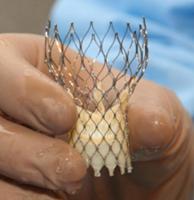
October 15, 2010 – An investigational trial of Medtronic’s CoreValve transcatheter aortic valve has been approved by the U.S. Food and Drug Administration (FDA) today. The investigational device exemption (IDE) pivotal clinical trial will enroll more than 1,200 patients at 40 U.S. clinical sites.
The CoreValve system is designed to provide a minimally invasive, nonsurgical treatment option for patients with symptomatic, severe aortic stenosis who are at high risk, or are ineligible, for open-heart surgery. Worldwide, approximately 300,000 people have been diagnosed with this condition. About one-third of these patients are deemed at too high a risk for open-heart surgery, the only therapy with significant clinical effect that is currently available in the United States. The CoreValve System will soon be under investigational use and is not yet commercially available in the United States.
The studies will evaluate the safety and efficacy of CoreValve in two groups of patients with severe aortic stenosis: those who have been deemed high risk for aortic valve surgery, and those who have been deemed at extreme risk for aortic valve surgery (i.e. inoperable).
“There is a distinct need for a new treatment option for many older patients with a severely diseased aortic heart valve and, as the population ages, this need continues to grow,” said Jeffrey Popma, M.D., Medtronic CoreValve U.S. pivotal trial co-principal investigator based at Beth Israel Deaconess Medical Center in Boston.
The CoreValve System is designed with self-expandable technology to replace a diseased aortic valve percutaneously, usually through the femoral artery, without open-heart surgery or surgical removal of the native valve. Since receiving CE (Conformité Européenne) mark in March 2007, the system has been implanted in more than 12,000 patients worldwide in more than 34 countries outside the United States.
“This study represents a significant opportunity to fundamentally change the way we treat Americans with severe aortic stenosis,” said David H. Adams, M.D., professor and chairman of the department of cardiothoracic surgery at The Mount Sinai Medical Center in New York City and co-principal investigator of the CoreValve trial. “Cardiologists and cardiac surgeons will collaborate more closely than ever before to carefully select and deliver this innovative therapy.”
Symptomatic Severe Aortic Valve Stenosis
Aortic stenosis is a condition of the aortic valve which prevents the valve from opening completely, thereby preventing healthy blood flow from the aorta to the rest of the body. While the heart initially compensates for stenosis by thickening its walls to help push blood through the valve, eventually this extra work weakens the heart and leads to an insufficient supply of oxygen-rich blood and sometimes causes a back-up of blood into the lungs. Untreated, aortic valve stenosis can lead to serious heart problems including heart failure and even death.
Study Details
The studies will evaluate the treatment’s safety and efficacy in two groups of patients with severe aortic stenosis: those who have been diagnosed as high risk for aortic valve surgery, and those who have been deemed at extreme risk for aortic valve surgery (i.e. inoperable).
Patients who are considered at high surgical risk will be randomized one-to-one to either transcatheter aortic valve implantation (TAVI) with CoreValve or to surgical aortic valve replacement (SAVR). The primary endpoint for this trial is freedom from all-cause mortality at 12 months.
Study participants deemed at extreme risk for surgical valve replacement will be randomized two-to-one to receive either TAVI with CoreValve or optimal medical management. This trial has co-primary endpoints: all-cause death or major stroke occurring within a minimum of 12 months of follow-up; and a composite of all-cause death, major stroke, days of hospitalization for aortic valve disease, and number of hospitalizations for aortic valve disease occurring within a minimum of 12 months of follow-up.
For more information: www.clinicaltrials.gov, www.medtronic.com

 September 02, 2026