June 7, 2011 — Research presented at the Society of Nuclear Medicine's annual meeting showed a novel optical imaging technique called near-infrared fluorescence (NIRF), which can image dangerous blood clots hiding inside elusive veins. The imaging technique uses light energy with a newly synthesized imaging agent to glean information about cells and tissues. The agent uses a biomarker that seeks out fibrin peptide that is actively involved in the formation of clots.
“This new near-infrared fluorescence agent is important in the field of molecular imaging because it offers very high-resolution imaging capabilities and has high translational potential,” says Tetsuya Hara, M.D., Ph.D., Massachusetts General Hospital, Boston, Mass. “Specifically, the agent’s fibrin peptide has already been tested in Phase II clinical trials. The availability of a high-resolution fibrin sensor is important for two reasons: intravascular NIRF imaging of coronary-sized arteries is now possible, and coupling the fibrin peptide with this technique may allow researchers to study coronary artery plaques and stents, which could potentially help us identify patients at increased risk of heart attack.”
Near-infrared fluorescence targets tissues by hitting them with near-infrared light energy that is absorbed by fluorophores — components of a molecule that make it fluorescent — and then emitted at a longer wavelength (fluorescence). Researchers can detect fluorescence signals by studying the wavelengths of light energy that is released from the tissues. This method can be used to evaluate patients for a range of diseases, such as cancer and Alzheimer’s disease, as well as cardiovascular disease, like deep vein thrombosis (DVT).
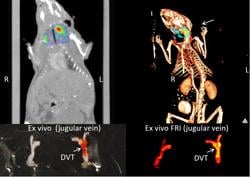
In conjunction with the new near-infrared fluorescence fibrin-targeted peptide, investigators were able to successfully detect fibrin-rich deep vein thrombosis with both intravital fluorescence microscopy and noninvasive fluorescence molecular tomography, which allows researchers to acquire information about tissues by analyzing how light is absorbed by and scattered from tissues. By coupling the fibrin peptide agent (EP-2104R) with rapidly emerging intravascular NIRF imaging, researchers now have the opportunity to study micro-thrombi on coronary artery plaques and coronary stents that are at especially high risk for thrombosis and vessel occlusion, the main cause of heart attacks. This could help clinicians predict potential heart attacks and other major cardiovascular events before it is too late, thus potentially saving the lives of patients.
For more information: www.snm.org
 August 06, 2026