October 14, 2011 — The American Society of Echocardiography (ASE) is preparing a guideline document on using strain echocardiography to evaluate cancer patients for early signs of cardiac toxicity due to their medical treatments. The group has also funded a research study to enhance identification of patients who are at risk.
The September 2011 death of 51-year-old Kara Kennedy of a heart attack brought the link between cancer treatments and cardiovascular damage into the spotlight for both patients and their physicians. Kennedy, the only daughter of Senator Edward M. Kennedy, was reportedly in remission after having been treated for lung cancer in 2002.
While the direct relationship between her cancer treatment and her death remain unclear, one theory links damage to her heart from her chemo treatments. With this tragedy, physician awareness of the link between specific cancer therapies and heart complications has renewed interest.
In the past, when cancer treatments were not very effective and cancer was usually fatal, little attention was paid to treatment complications. With the advent of more successful cancer therapies that have raised survival rates, concerns about their long-term effects have now become paramount.
“There are 2.2 million survivors of breast cancer in the U.S. alone,” said Juan Carlos Plana, M.D., co-director of cardio-oncology, Cleveland Clinic, “and heart disease, not cancer, is the biggest risk they face.”
When a patient is diagnosed with breast cancer, she (or he) is tested for the HER2 mutation, an aggressive form of cancer that affects 20-25 percent of breast cancer patients; it is typically treated with Doxorubicin, followed by Herceptin.
Unfortunately, as many as one third of patients receiving these two drugs will develop cardiotoxicity, and some will progress to full-blown heart failure. This means they could potentially need mechanical devices or heart transplants in order to survive.
The advent of strain echocardiography for early identification of cardiac problems is great news for those suffering from many forms of cancer. “The goal is not to stop cancer therapy, but to identify cardiotoxicity early and to protect the heart with medications so heart failure does not become a problem and the cancer treatment can be continued,” Plana explained. “Currently, 17 percent of patients receiving treatment for the most aggressive form of breast cancer have to stop therapy due to heart issues. The sensitivity of strain echo allows early detection so oncologists can treat their patients without fear of the downstream effects of the therapies.”
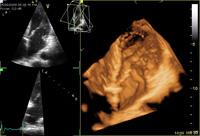
Plana, who is an ASE fellow and served as medical director of cardiac imaging at Houston’s MD Anderson Cancer Center, now heads a newly-formed cardio-oncology center at the Cleveland Clinic; every patient slated for a cancer therapy with toxicity potential receives an intensive left-ventricular mechanics protocol, which includes both 3-D echocardiography with contrast and strain imaging.
To highlight screening benefits, ASE has collaborated with the European Association of Echocardiography (EAE) and the American Society of Clinical Oncology (ASCO) in a guideline writing group, led by Plana. A previous paper entitled “Early Detection and Prediction of Cardiotoxicity in Chemotherapy-Treated Patients,” has already outlined exciting progress in this area. ASE expects its new guideline to be available in 2012.
The ASE Education and Research Foundation has also funded a Career Development Award on the use of strain and 3-D echocardiography; the goal is to identify patients at high risk for heart complications even before they start chemotherapy. The lead researcher, ASE member Timothy Tan, MBBS, Ph.D., clinical and research fellow, Massachusetts General Hospital and Harvard Medical School, hopes the research “will increase the understanding of heart failure associated with cancer treatment, potentially helping to decrease its morbidity and mortality.”
For more information: www.asecho.org
 September 02, 2026