September 19, 2012 — Heart catheter procedures guided by magnetic resonance imaging (MRI) are as safe as X-ray angiography-guided procedures and take no more time, according to a pilot study conducted at the National Institutes of Health (NIH). The results of the study indicate that real-time MRI-guided catheterization could be a radiation-free alternative to certain X-ray-guided procedures. A report of the study, which was conducted by researchers within the intramural program of the NIH’s National Heart, Lung, and Blood Institute (NHLBI), is available online in the European Heart Journal.
"This could be the first chapter of a big story," said Robert S. Balaban, Ph.D., scientific director of the NHLBI's Division of Intramural Research. "It provides evidence that clinical heart catheter procedures are possible without using radiation, which could be especially valuable in areas such as pediatrics."
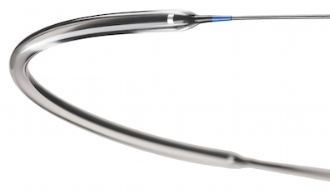
The research team performed transfemoral catheterization (guiding a catheter from the large vein in the leg to the heart) in 16 patients to examine the right side of the heart, including the attached veins and the pulmonary arteries. The study’s volunteers all needed catheterization for heart and valve disease. The researchers performed the procedure in the 16 patients using X-ray guidance, and then repeated it twice using real-time MRI guidance of a balloon-tipped catheter filled with air or with a contrast agent.
The MRI and X-ray catheterizations were successful in 15 of the 16 participants. One patient had required the use of a wire to help guide the catheter under X-ray, and currently no guidewires are available that work under an MRI.
The average procedure time for the two approaches was comparable — about 20 minutes. The team expected the MRI-guided procedure to take much longer because an MRI-compatible catheter can be harder to see in an MRI-generated image than a conventional steel catheter can be in an X-ray-generated image.
"Developing safe and conspicuous catheter devices for MRI is the chief obstacle to overcome before this approach can be widely applied at hospitals," said study lead Robert J. Lederman, M.D., a senior investigator in the NHLBI's Cardiovascular and Pulmonary Branch. "But with improved tools and further improvement of the procedure, real-time MRI catheterization may become a realistic option for many people."
Lederman's research group is still performing MRI catheterization on additional patients, and is currently designing improved catheters and other tools that will be more visible under MRI to help move this technology forward. In addition to guiding catheter procedures, the NHLBI team also hopes to use MRI to guide nonsurgical catheter treatments in the future.
For more information: http://clinicaltrials.gov/ct2/show/NCT01287026

 September 02, 2026