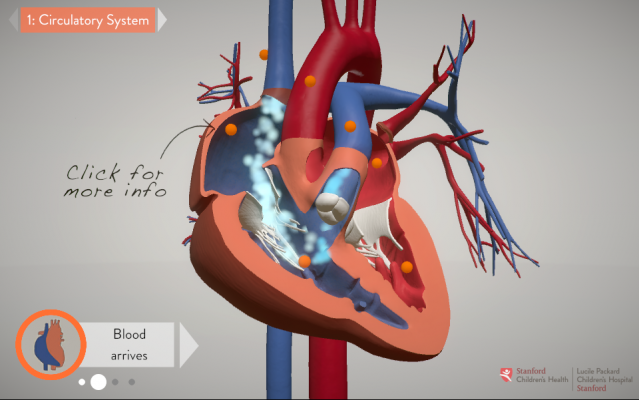
October 9, 2014 — Stanford Children’s Health is using cutting-edge videogame technology to get parents the information they need about the complex medical procedures their children might face. In a newly launched collaboration between Silicon Valley’s Lighthaus Inc. and Stanford Children’s Health, they created interactive 3-D graphics to walk parents through a risky and complicated heart surgery.
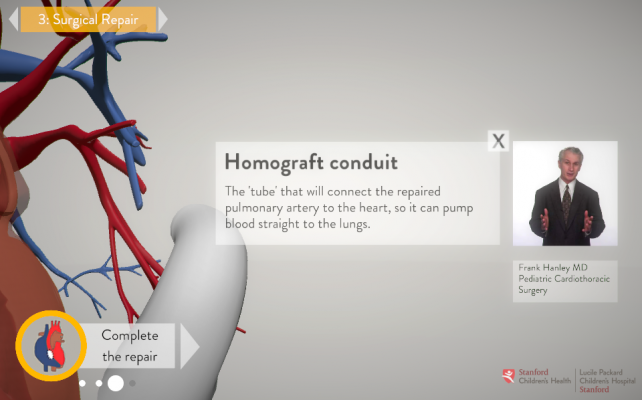
The first graphic gives stressed-out parents of children born with a deadly heart defect a peace of mind that’s simply not possibly from a napkin sketch. At 3Dheart.stanfordchildrens.org, cardiothoracic surgeon Frank Hanley, M.D., and digital storyteller David Sarno have created a three-dimensional tool that simplifies a unique surgery called unifocalization, which Hanley said “is the most complicated surgery I do.”
The surgery is lifesaving for children born with a deadly series of heart defects called tetralogy of Fallot with pulmonary atresia and major aortopulmonary collateral arteries. Before finding Hanley, parents are often told there is nothing that can be done for their child. For those looking for better answers, there’s Hanley. He’s the inventor of unifocalization’s one-stage repair, a long and grueling, fix-it-all-at-once approach that has saved hearts from the United Kingdom to South Africa to New York — and with a 98 percent success rate.
Hanley and Sarno have used the tools of the videogame industry to visually inform these parents how their child’s heart is impaired, and how unifocalization will fix it. The graphic is so accessible that a parent can even perform a simple simulation of the surgery.
“What we’ve discovered is that the same technology the gaming industry uses to conjure alien planets works beautifully for re-creating and exploring the inside of the human body,” Sarno said.
This means families, and even referring doctors, can easily grasp this complicated and lifesaving surgery in the moment when it could make the biggest difference for their child or patient. It’s all part of an innovative new program called Moving Medicine: An Interactive 3-D Look at Conditions & Treatments.
Hanley is now using the graphic as a standard part of parent orientation before the surgery. Coming up next, Stanford Children’s Health is working with Sarno’s team on an interactive animation to demystify a type of pediatric brain surgery, and have plans to extend the rollout to explain additional heart conditions, orthopedic surgeries and more.
For more information: 3Dheart.stanfordchildrens.org

 July 08, 2024