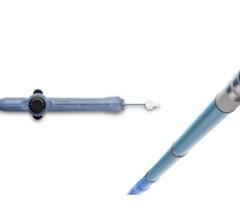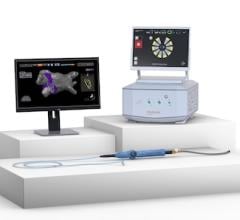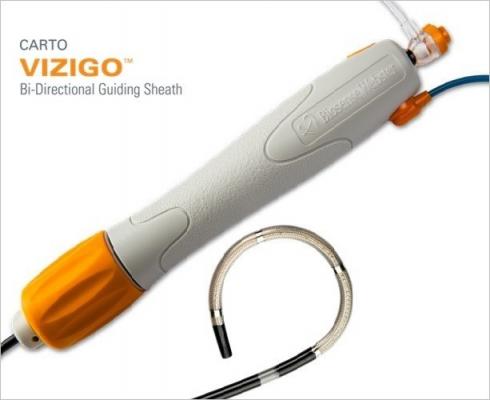
October 29, 2018 — Good Samaritan Hospital recently became the first hospital on the West Coast to utilize the Carto Vizigo bi-directional guiding sheath. The sheath can be visualized on the Carto 3 System during a catheter ablation procedure, helping electrophysiologists reduce dependency on fluoroscopy.
A sheath is an introducer routinely used by physicians to facilitate catheter access, stability and tissue contact when targeting sites for catheter ablation to treat arrhythmias. Electrophysiologists rely on fluoroscopy to identify the location of the sheath, therefore requiring use of lead to protect themselves from radiation during the procedure.
According to Ivan Ho, M.D., electrophysiologist practicing at Good Samaritan Hospital and the first to use the technology on the West Coast, the long deflectable sheath has become a major step forward in achieving catheter stability and appropriate radiofrequency energy delivery in complex left-sided arrhythmia ablations. "One of the limitations has been the need of periodic fluoroscopic imaging of the sheath's relative position with the catheter to optimize contact with endocardial surface and ensure safety due to the relatively stiff shaft of these sheaths," said Ho. The Vizigo allows the direction of the sheath and its relationship with the catheter to be visualized accurately on a 3-D mapping system, minimizing the use of fluoroscopy and overall procedure time.
This new technology is incorporated easily into the physicians' workflow, designed to enhance efficiency during mapping and positioning of the ablation catheter. The smooth tip-to-dilator transition promotes ease of entry into the left atrium during transseptal access, while deflections of 180 degrees in both directions mean increased steerability, which may improve access to hard-to-reach sites.
For more information: www.biosensewebster.com
 September 08, 2026