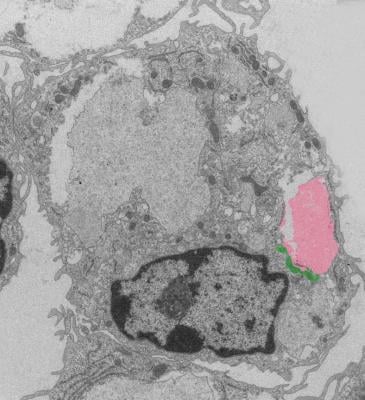
A macrophage immune cell, with a dead cell (pink) that has been eaten, and a mitochondrion (green) between the dead cell and the nucleus. The study’s findings indicate that what the macrophage eats is taken up by the mitochondrion, which in turn communicates with the nucleus to activate the macrophage to promote tissue repair. Image courtesy of Northwestern Medicine.
January 30, 2019 — Northwestern Medicine scientists have discovered a novel signaling pathway that promotes healing after a heart attack. The study, published in Cell Metabolism, demonstrates for the first time that the metabolism of dead heart cells by macrophages reprograms the immune cells to launch an anti-inflammatory response and stimulate tissue repair.
“Targeting this pathway may have therapeutic benefit for a broad range of acute and chronic disorders — not only heart attacks — by enhancing the active resolution of inflammation,” said principal investigator Edward Thorp, Ph.D., associate professor of pathology and a member of the Feinberg Cardiovascular and Renal Research Institute (FCVRI).
Shuang Zhang, Ph.D., who recently graduated from Feinberg’s Driskill Graduate Program in Life Sciences (DGP), was the first author.
The Thorp Laboratory studies how immune cells regulate wound healing, in particular after myocardial infarction, or heart attack. After a patient has experienced a heart attack, immune cells are essential for removing dead or dying heart cells. If the cells are not cleared efficiently, they can lead to prolonged inflammation and cause further damage to the heart.
There are currently few effective treatments to enhance the healing process after a heart attack, and many patients go on to develop heart failure as a result of the damage.
The Thorp Laboratory has published extensively on efferocytosis — the process by which immune cells called macrophages engulf and ingest dying cells — and its critical role in turning on inflammation resolution after heart attack. But the intracellular mechanisms of the process remained unclear.
In the new research, the scientists discovered that when macrophages swallow dead heart cells during efferocytosis, the macrophages fill with metabolites that reprogram the cell to initiate an anti-inflammatory response and promote repair of the heart.
“Our findings elucidate a novel process by which dead tissue metabolites are recycled to fuel wound healing,” Thorp explained. “It extends the meaning of ‘you are what you eat’ to the cellular level.”
In an experimental model, the scientists further demonstrated that when mitochondria — an organelle which regulates metabolism — are defective, healing after cardiac injury is impaired.
The findings suggest a novel role for immune cell metabolism beyond the production of energy.
“The idea that mitochondria, or overall metabolism, can act as a dictator of the cell and control macrophage function — that’s very novel,” Zhang said.
The Thorp Laboratory is continuing to investigate metabolic control of human immune cell function in further studies of cardiac injury and organ transplantation. Zhang is beginning a post-doctoral fellowship at Harvard Medical School, where she will continue her study of immune cells.
For more information: www.cell.com/cell-metabolism
Reference
1. Zhang S., Weinberg S., DeBerge M., et al. Efferocytosis Fuels Requirements of Fatty Acid Oxidation and the Electron Transport Chain to Polarize Macrophages for Tissue Repair. Cell Metabolism, Dec. 27, 2018. https://doi.org/10.1016/j.cmet.2018.12.004
 September 02, 2026