December 30, 2019 — Acoustoelectric cardiac imaging, a new, noninvasive cardiac imaging technology developed at the University of Arizona, has been licensed to startup ElectroSonix.
Russell Witte, College of Medicine – Tucson and BIO5 Institute professor of medical imaging, optical sciences and biomedical engineering, developed the patented technology that provides improvements over current cardiac imaging technologies such as electroanatomical mapping, which provides low-resolution images that make it difficult to pinpoint the exact location of arrhythmias.
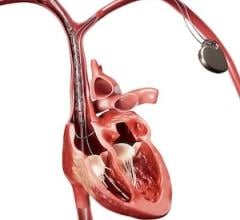
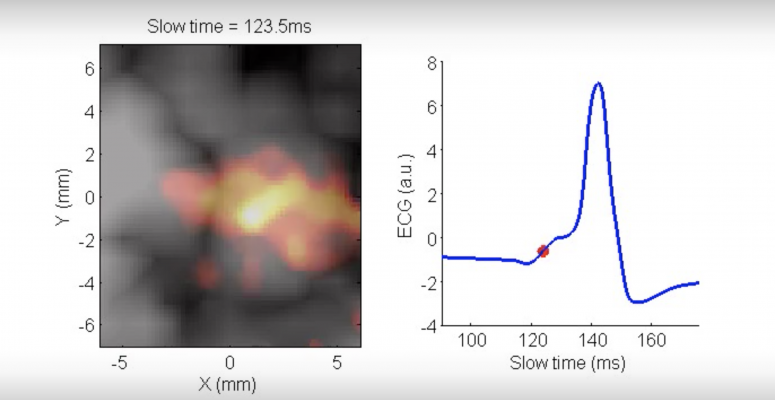
Acoustoelectric cardiac imaging, or ACI, works by emitting ultrasound waves that interreact with the heart’s electrical currents to produce a map of electrical activity. The imaging technique allows physicians to acquire precise, real-time data before, during and after cardiac ablation procedures, which are used to scar or destroy tissue that is allowing incorrect electrical signals to cause an abnormal heart rhythm.
The ability of acoustoelectric imaging to map electrical systems in the body makes the technology applicable to nearly all bodily functions that rely on electrical signals. Witte, whose doctorate in bioengineering included a focus on neural engineering, began his research by looking at the electrical signals in the brain.
“One of the things that we learned was that in order to look at the brain electrically at a resolution on a scale of millimeters and milliseconds, you needed to use invasive tools,” he said.
Witte pursued the idea of using ultrasound as a way to map electrical signals in the brain accurately without the need for invasive techniques. As his research has developed, Witte realized the technology could be applied to nearly all parts of the body relying on electrical signals, including the heart.
In 2013, Witte engaged Tech Launch Arizona, the office that commercializes inventions developed through university research, to maximize the impact of his work by bringing the new heart imaging technique to market. Some of the services Tech Launch Arizona provided for the newly formed startup included patent prosecution and licensing, market research, financial analysis, pitch deck preparations and funding for invention development through its Asset Development program. Witte and Vohnout also took part in the TLA-hosted customer discovery program I-Corps.
As chief science officer, Witte oversees the development and implementation of innovations and intellectual property at ElectroSonix. Co-founder Sonia Vohnout, chief operations officer at ElectroSonix and a UArizona alumna, oversees business development, fundraising and the company’s operations.
Eric Smith, executive director of the University of Arizona Center for Innovation at Tech Parks Arizona, originally connected Vohnout and Witte.
“He knew my areas of interest and also knew that my husband had heart issues, so this invention was one I would have a personal connection to,” Vohnout said.
ElectroSonix's current focus is cardiac imaging, but Witte and Vohnout say they will be exploring other opportunities in the future. The company licensed UArizona patents for acoustoelectric imaging for both the heart and brain.
The team continues to reach important milestones, including receiving a Small Business Innovation Research grant from the National Institute of Health that is allowing them to further develop their technology. Most recently, ElectroSonix became a client of the UArizona Center for Innovation.
More than 4 million people in the U.S. suffer from cardiac arrhythmias and over 1,000 die each year. Current conventional methods are labor-intensive, error-prone and often ineffective for identifying arrhythmias. These limitations increase the chances of complications and the need for subsequent procedures. With over 500,000 cardiac ablations performed each year and a market forecasted to reach $4.5 billion by 2020, the demand for safer and more accurate procedures continues to grow.
For more information: www.electrosonix.net

 August 17, 2026