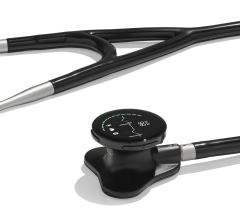
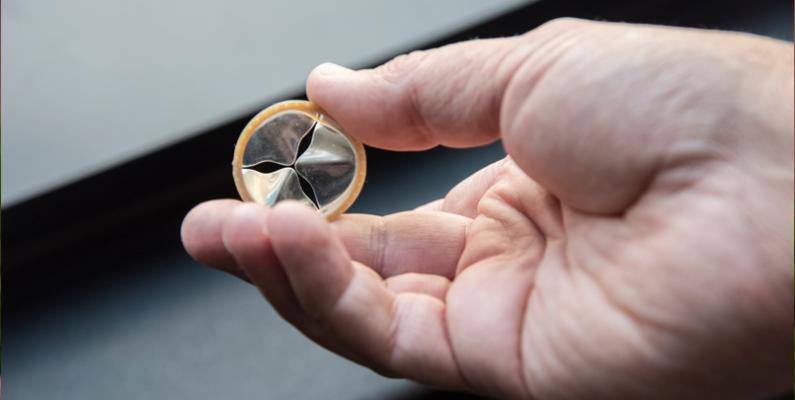
The Tria biopolymer surgical aortic valve displayed at Beaumont Hospital, Royal Oak.
December 13, 2021 - Foldax Inc. announced that the Drugs Controller General of India (DCGI), India’s regulatory body for medical devices, has approved initiation of a clinical trial of the Tria biopolymer surgical aortic heart valve. The Tria valve reimagines the heart valve by combining the company’s proprietary biopolymer – LifePolymer – with an innovative valve design intended to resist calcification, withstand stresses and strains without failure, and restore patient quality of life without lifelong use of anticoagulants.
The trial will study the ability of the Tria biopolymer aortic valve to surgically treat patients with aortic valve disease and lead to commercial approval in India.
Today, 70 percent of aortic valve replacements being performed in India implant mechanical valves. Mechanical valves are durable but require life-long anticoagulant use to minimize blood clotting. Anticoagulant therapy creates an ongoing bleeding risk that can limit a patient’s lifestyle, diminish their quality of life, and potentially lead to hemorrhage and death.
“After promising outcomes from our U.S. early feasibility study, we are excited to expand our clinical study of the Tria biopolymer valve globally, beginning in India. This study is the first step to commercializing our device outside of the U.S.,” said Frank Maguire, chief executive officer of Foldax. “Our platform technology is well suited to one of the largest heart valve replacement markets in the world that has relied on mechanical heart valves to treat both aortic and mitral disease. The Tria valves are designed to be uniquely durable while sparing patients from the negative consequences of blood thinning medication. Additionally, our robotic manufacturing process allows us to consider in-country manufacturing with the same precision and quality as our U.S.-based manufacturing.”
Tria is the first and only heart valve to be robotically produced, which is possible due to its polymer leaflets that can be consistently manufactured with precise thicknesses and are designed to achieve a valve with predictable lifetime performance.
The Tria heart valve is for investigational use only and is not available for commercial sale.
For more information: www.foldax.com
 October 23, 2026