June 4, 2025 — A new study published in The Annals of Thoracic Surgery, a journal from The Society of Thoracic Surgeons, finds that Medicare patients with atrial fibrillation (AF) who undergo surgical ablation during isolated coronary artery bypass grafting (CABG) live longer than those who do not, offering compelling support for clinical guidelines that recommend this procedure but are too often not followed in practice.
Researchers examined Medicare claims data from more than 87,000 patients with preexisting AF who underwent CABG between 2008 and 2019. Overall, only 22% of studied patients received concomitant surgical ablation during CABG, and, although the prevalence of ablation did increase over the study period, ablation rates were only 27% in 2019 (two years after a Class I recommendation for ablation was published by the Society of Thoracic Surgeons).
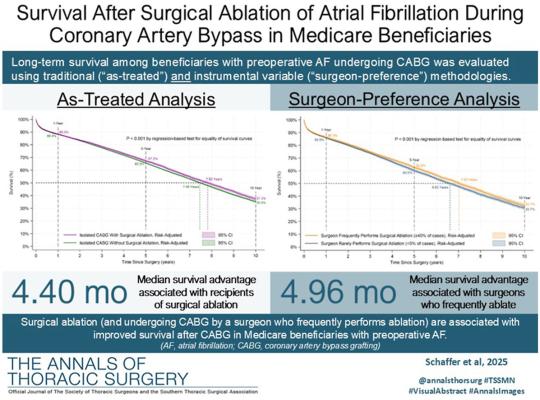
The study found that surgical ablation during CABG was associated with a risk-adjusted median survival advantage of 4.4 months compared to patients who did not receive ablation (7.82 vs. 7.46 years; P<0.001). Patients treated by surgeons who frequently performed ablation had a median survival advantage of nearly five months (7.03 vs. 6.62 years; P<0.001) compared to those treated by surgeons who rarely performed the procedure.
“This study is one of several recent analyses suggesting that surgical ablation may meaningfully improve survival in patients with preexisting atrial fibrillation undergoing CABG,” said Justin Schaffer, MD, lead author of the study and medical director of surgical outcomes at Baylor Scott & White – The Heart Hospital. “Our analysis found that the treatment effect of surgical ablation for AF manifested late, over two years after CABG. We hypothesize this is because ablation leads to a decreased incidence of tachycardia-related heart failure, which translates to improved late survival.”
To reduce bias related to the fact that healthier patients are more likely to receive ablation, the researchers used two advanced statistical methods.
One method (overlap propensity score weighting) adjusted for measured differences between patients, while the other (a surgeon-preference instrumental variable analysis) compared outcomes among patients treated by surgeons who frequently ablate and those who rarely do. This method simulates the effects of randomization by leveraging variation in in clinical practice among surgeons to balance unmeasured differences between patients. Under certain assumptions, patients can be thought of as being pseudo-randomly distributed among surgeons with different approaches to ablation.
“We used both as-treated and surgeon-preference analyses to provide a more complete picture of ablation’s potential benefits,” Dr. Schaffer explained. “While each method has strengths and limitations, the consistency of findings across both approaches is encouraging, especially given that a large-scale randomized trial in this area does not appear forthcoming.”
Between 10% and 20% of patients undergoing CABG have atrial fibrillation before surgery, a condition that is associated with both perioperative complications and reduced long-term survival. Prior research has shown that surgical ablation can help restore normal heart rhythm and improve long-term outcomes, but the practice remains underutilized.
“These data underscore the importance of guideline adherence and hopefully will lead to a reevaluation of surgical decision-making for patients with AF,” added study coauthor John Squiers, MD, Baylor Scott & White The Heart Hospital.
The full study, “Association of Surgical Ablation During Coronary Artery Bypass Grafting with Survival in Patients with Preexisting Atrial Fibrillation,” is now available online in The Annals of Thoracic Surgery.

 August 26, 2026