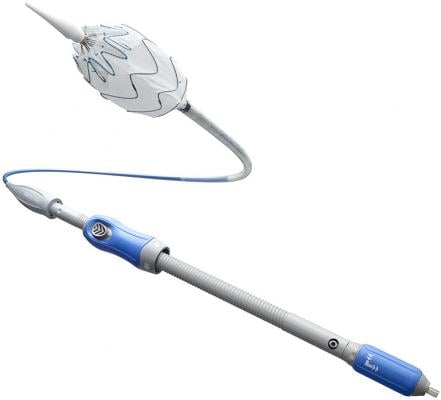
February 7, 2019 — Medtronic plc recently received U.S. Food and Drug Administration (FDA) approval for the Valiant Navion thoracic stent graft system. The device is indicated for the minimally invasive repair of all lesions of the descending thoracic aorta, including thoracic aortic aneurysms (TAA), blunt thoracic aortic injuries (BTAI), penetrating atherosclerotic ulcers (PAU), intramural hematomas (IMH) and aortic type B dissections (TBAD).
Until now, patients with small iliac arteries were considered ineligible for thoracic endovascular aneurysm repair (TEVAR), or required adjunctive procedures to accommodate calcification and tortuosity concerns. Valiant Navion allows for the potential for more patients to receive a percutaneous procedure and overcome these anatomical concerns, enabling a less invasive approach to treatment compared to surgical cut-down (open) procedures.
The Valiant Navion is a lower-profile evolution of the Valiant Captivia thoracic stent graft system, which has treated more than 100,000 patients globally. Valiant Navion is built on the design philosophy of the Valiant Captivia system for improved performance and increased patient applicability. The system also features both CoveredSeal (proximal covered) and FreeFlo (proximal bare metal) stent configurations, providing physicians with two graft options to treat varying patient anatomies and pathologies.
“A significant reduction of the delivery system profile enables physicians to better facilitate the endovascular treatment of patients with smaller, tortuous, and calcified access vessel arteries,” said Ali Azizzadeh, M.D., the U.S. principal investigator for the Valiant Navion IDE study. “Furthermore, the challenging anatomical and comorbid baseline characteristics and resulting clinical evidence of the global investigational device exemption (IDE) subjects support this design.”
Approval was based on 30-day primary endpoint analysis of 87 subjects consecutively enrolled in the international, multicenter, prospective investigational device exemption (IDE) study analyzing the safety and efficacy of Valiant Navion in subjects with TAA and PAU. The study included a challenging real-world patient population with 37.9 percent female enrollment and 71.3 percent subjects with severe to life-threatening systemic disease (ASA physical status classification III/IV). The results demonstrated efficacy, with:
-
FreeFlo configuration implanted in 74.7 percent of procedures with no instances of access or deployment failures at implant in the full study cohort; and
-
The new CoveredSeal proximal configuration implanted in 25.3 percent of procedures with no instances of access or deployment failures at implant in the full study cohort.
The majority of procedures (50.6 percent) were performed through a percutaneous access approach, leading to operational efficiency with mean procedure and fluoroscopy times of 88.7 ± 53.4 minutes and 12.2 ± 8.8 minutes, respectively.
Through 30 days, data showed low rates of peri-operative mortality at 2.3 percent (2/87) and secondary procedures at 2.3 percent (2/87). The rate of Type Ia endoleaks was 1.2 percent (1/87) at one-month imaging follow-up.
For more information: www.medtronic.com

 August 28, 2026