
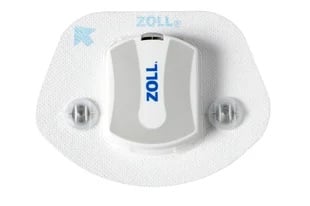
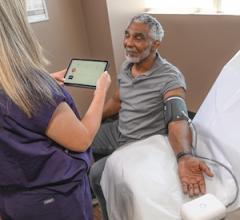
The Heart Failure Management System (HFMS) is a patch-based system used for at-home monitoring of lung fluid levels in patients with heart failure. (All photos: ZOLL)
Heart failure (HF) management requires consistent monitoring and early intervention to prevent complications and reduce hospital readmissions. For physicians, achieving these goals can improve patient outcomes while easing the financial burden of repeated hospital stays.
A new case study released by ZOLL in collaboration with Kettering Health highlights the real-world results of its HF management system (HFMS), demonstrating a reduction in the hospital’s HF rehospitalization ratio during its first year of use.
Real-World Results
The case study reports that Kettering Health reduced its HF observed-over-expected rehospitalization ratio from 1.30 to 0.89 during its first year using HFMS. This represents a substantial improvement in the health system’s performance against expected readmission rates.
Kettering Health’s reduction marks a shift from performing worse than expected to achieving fewer HF hospitalizations than anticipated. This improvement is particularly relevant for hospitals working to strengthen care transitions, identify worsening symptoms earlier and prevent avoidable admissions.
The improved results are also expected to contribute to a stronger standing under the Hospital Readmissions Reduction Program (HRRP). By reducing excess readmissions, hospitals may improve their performance and limit potential financial penalties.
How the Heart Failure Management System Works
ZOLL’s HFMS is a noninvasive, radiofrequency-based wearable monitoring platform designed to continuously assess pulmonary fluid status. Fluid accumulation in the lungs can be a sign of worsening HF, sometimes developing before patients experience symptoms severe enough to require hospital care.
HFMS is designed to provide healthcare teams with information that can support earlier assessment and intervention. This may help clinicians identify patients whose conditions are deteriorating and respond before their symptoms progress to a point requiring hospitalization.
Readmissions and Financial Impact
HF readmissions can place considerable demands on patients, caregivers and healthcare systems. Each hospitalization may involve additional treatment costs, disruptions to daily life, and increased risks associated with acute illness. Preventing avoidable readmissions is therefore an important goal for hospitals seeking to improve both the quality and efficiency of care.
Kettering Health’s results highlight the potential value of combining continuous monitoring with established HF management practices. Identifying signs of worsening fluid status earlier may give clinical teams more opportunities to intervene, adjust treatment when appropriate and support patients outside the hospital setting.
The financial implications are also significant. Under the HRRP, hospitals can face Medicare payment reductions when their risk-adjusted readmissions exceed expected levels for certain conditions. Improving readmission performance may help hospitals strengthen their standing under the program while directing resources toward proactive patient care.
“Cost of monitoring is very low to the health system if you are able to leverage existing resources,” says Isaac Humphrey, MD, chief of staff and head hospitalist at Kettering Health. “There is some time spent with the monitoring (a few hours a week) and also for education and fitting (one to two hours per week). Otherwise, there is little to no monetary cost to the health system. For systems struggling with readmissions, there are potentially millions at risk from HRRP penalties, and reductions similar to ours can help a system realize a large financial impact.”
What the Findings Mean
The Kettering Health case study provides a real-world example of how wearable monitoring technology can support efforts to improve HF management. Its reported reduction in the observed-over-expected rehospitalization ratio demonstrates a meaningful improvement during the first year of HFMS use.
Although the findings are encouraging, the results should be interpreted within the context of the individual hospital’s experience. A case study doesn’t establish that the system alone caused the improvement or that other healthcare organizations will achieve identical results. Factors such as patient populations, clinical workflows, and existing readmission prevention strategies can influence outcomes.
Nevertheless, the findings reinforce the importance of moving beyond episodic assessments toward more proactive approaches to chronic disease management. When clinicians have access to information about changes in a patient’s condition, they may be better positioned to identify emerging concerns and respond before hospitalization becomes necessary.
“I do believe that this can be successfully scaled across a system,” Dr. Humphrey states. “Since our pilot project concluded, we have scaled our program to include all seven hospitals in our system and dramatically increased our monitoring volume. We have been able to do that with the same personnel we were using for the pilot study.”
A More Proactive Approach
ZOLL’s collaboration with Kettering Health illustrates the potential of continuous pulmonary fluid monitoring to support better HF outcomes. By reducing its observed-over-expected rehospitalization ratio in the first year of HFMS use, Kettering Health achieved a notable improvement in readmission performance. The results highlight how technology-supported monitoring may help hospitals reduce avoidable readmissions, improve patient care, and provide more sustainable healthcare delivery.
References
-
Webinar: How Kettering Health Beat the Benchmark on 30-day Heart Failure Readmissions. Published 2026. cardiac.zoll.com/hfms-kettering-webinar
-
American Lung Association. Everything you need to know about pulmonary edema. www.lung.org/blog/pulmonary-edema
-
Baris RO, Tabit CE. Heart Failure Readmission Prevention Strategies - A Comparative Review of Medications, Devices, and Other Interventions. J Clin Med. Aug. 21, 2025;14(16):5894. doi: 10.3390/jcm14165894. PMID: 40869719; PMCID: PMC12387320. pmc.ncbi.nlm.nih.gov/articles/PMC12387320/
 November 13, 2026