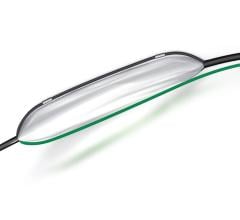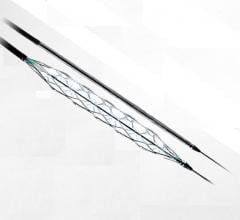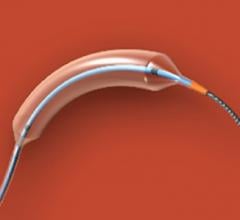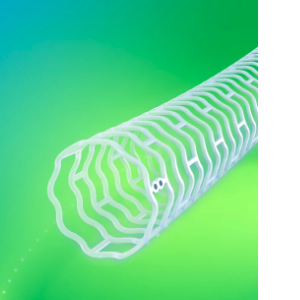
Esprit BTK System (Photo: Abbott)
Aug. 25, 2025 — Abbott has received CE Mark in Europe for the Esprit BTK Everolimus Eluting Resorbable Scaffold System (Esprit BTK System), for people with peripheral artery disease (PAD) below the knee (BTK). The Esprit BTK System is designed to keep arteries open and deliver a drug called everolimus to support vessel healing prior to completely dissolving over time.
Fifty million Europeans are living with PAD1. Until now, the standard treatment approach is often balloon angioplasty, which involves delivering a small balloon via a catheter to the blockage to open the vessel and restore blood flow. However, blockages treated with only balloon angioplasty can be associated with poor short- and long-term results. In many instances the vessels become blocked again, requiring additional treatment.
The Esprit BTK System is the first resorbable scaffold of its kind for use below the knee. Made of material similar to dissolving sutures, the stent is implanted through a minimally invasive, catheter-based procedure via a small incision in the leg. Once the blockage is cleared, the Esprit BTK scaffold helps heal the vessel and provide support until the vessel can remain open on its own, after which the scaffold resorbs.
In November 2024 at the Vascular InterVentional Advances (VIVA) Conference, Abbott released late-breaking clinical data on the LIFE-BTK trial two-year results. The trial demonstrated that compared to balloon angioplasty, the Esprit BTK System results in improved patient outcomes and 48% fewer repeat procedures over the study period.
CE Mark
"For too long, patients with severe PAD below the knee have had limited treatment options and were often faced with potential amputations," said Professor Dierk Scheinert, M.D., University Hospital Leipzig and Head of the Department Angiology. "With CE Mark, the Esprit BTK System offers a resorbable scaffold backed by strong data and proven superiority over balloon angioplasty — giving physicians a novel, innovative tool to treat the most severe forms of PAD more effectively and improve patient outcomes across Europe."
PAD is highly prevalent, yet many people have never heard of the condition. Approximately 50 million people are living with PAD in Europe, roughly twice the number affected in the United States.2 This painful disease occurs when arteries become clogged with plaque, preventing blood flow and oxygen from reaching the lower legs and feet. These blocked vessels often lead to severe pain, non-healing wounds, and in some cases, limb amputation, significantly impairing the ability to walk and quality of life. Over a ten-year period, the most severe form of PAD has shown to have only a 25% survival rate.3
"With the Esprit BTK System, we're helping to restore blood flow without leaving a permanent implant behind. Our resorbable program is focused on delivering meaningful innovation in the peripheral anatomy to help patients live healthier, fuller lives," said Samih Al Mawass, divisional vice president of Europe, Middle East & Africa at Abbott's vascular business.
As part of Abbott's continued commitment to helping all people live healthier lives, physicians can find more PAD education information at CLEAR.abbott/INT.
The Esprit BTK System received U.S. FDA approval in April 2024.
For important safety information on Esprit BTK System, visit www.cardiovascular.abbott/us/en/hcp/products/peripheral-intervention/esprit-btk-resorbable-scaffold-system/important-safety-information.html.
-
Epidemiology of Peripheral Artery Disease: Narrative Review. L Horvath et al. Life 2022, 12, 1041. https://doi.org/10.3390/life12071041
-
Dattani R, Sayers R. Peripheral artery disease: current diagnosis and management. Br J Cardiol. 2020;27(1). https://bjcardio.co.uk/2020/03/peripheral-artery-disease-current-diagnosis-and-management/
-
Sartipy, F. , et al. Ten Year Mortality in Different Peripheral Arterial Disease Stages: A Population Based Observational Study on Outcome. European Journal Endovascular Surgery. 2018, 55, 529-536. https://pubmed.ncbi.nlm.nih.gov/29478910/

 June 13, 2024