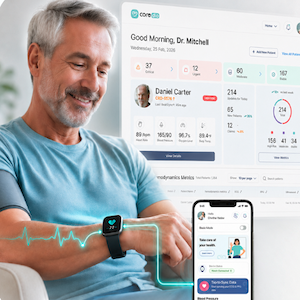
May 28, 2026 — Coredio has announced that the U.S. Food and Drug Administration (FDA) has granted its Cardiac Performance Simulation Engine (CPSE) Breakthrough Device Designation and accepted the platform into the FDA’s Total Product Life Cycle Advisory Program (TAP). CPSE is a software-only platform designed to deliver catheterization-comparable hemodynamic assessment using consumer smartwatches and standard blood pressure cuffs in clinical and home settings under physician supervision.
Coredio is now on an accelerated, priority path toward 510(k) submission. For many HF patients, the most vulnerable period begins when they leave the hospital. Clinicians often lose visibility into cardiac decompensation until symptoms become severe enough to trigger another ER visit or hospital readmission.
“Heart failure management has long been limited by the gap between what we can measure in the hospital and what we can reliably understand once patients return home,” said Dr. Jagmeet P. Singh, MD, PhD, Mass General Brigham. “Coredio’s approach, using wearable-derived signals and physics-informed AI to estimate hemodynamic status noninvasively, has the potential to give clinicians a more holistic view of patient cardiac function and enable earlier intervention.”
CPSE is device-agnostic and designed to bring hemodynamic assessment into the home and physician office using wearables patients already own.
CPSE is a software-only platform with proprietary algorithms designed to identify abnormal status across four key hemodynamic parameters used by cardiologists to assess whether HF patients are stable or deteriorating. These include left ventricular end-diastolic pressure (LVEDP), central venous pressure (CVP), systemic vascular resistance (SVR), and cardiac index (CI), enabling a more holistic view of both left- and right-sided HF.
“At White Plains Hospital, our transitional care program focuses on the critical weeks after discharge, when heart failure patients are most vulnerable and least connected to their care team,” said Dr. Farrukh Jafri, MD, White Plains Hospital. “What drew us to Coredio is its potential to bring hemodynamic-level data into that gap, without requiring invasive devices or additional clinical visits.”
CPSE pairs a physics-based digital twin of the patient's cardiovascular system with machine learning trained on clinical data. After an initial personalization step, patients use a smartwatch and standard blood pressure cuff for on-demand indication of hemodynamicstatus for clinician review.
“Heart failure management has long been limited by the gap between what we can assess invasively or with imaging tools and what we can see at home,” said Dr. Jennifer Monti, Cardiologist, SSM Health. “Coredio’s approach, extracting catheterization-comparable hemodynamic data from consumer wearables using physics-based AI, has the potential to close that gap and give clinicians the visibility they need to intervene earlier and make moreinformed decisions for heart failure patients.”
FDA Breakthrough Device Designation
“We’re proud that Coredio has been granted FDA Breakthrough Device Designation and is enrolled in TAP” said Mehdi Mortazawy, Co-Founder & CTO, Coredio. “CPSE fuses a physics-based digital twin of the cardiovascular system with advanced AI to noninvasively classify the four hemodynamic parameters central to HF management. These designations from FDA reflect the scientific rigor and the urgency of the unmet need in HF management and how Coredio is poised to help cardiology specialists and their patients meet this need in the future.”


 September 09, 2026