
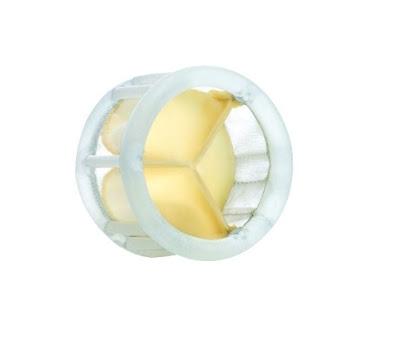
Image courtesy of Direct Flow Medical
November 10, 2015 — PinnacleHealth CardioVascular Institute enrolled the first patient in Pennsylvania in a randomized trial studying a new heart valve to treat aortic valve disorders. Harrisburg Hospital is the only trial site in Pennsylvania. This study represents the next wave of research with aortic valves that conform to the patient's anatomy.
According to an article published in the Journal of the American College of Cardiology, aortic stenosis (AS) is the most common valvular heart disease in developed countries with prevalence estimated between 3 and 23 percent. AS mainly affects older people, due to scarring and calcium buildup in the valve cusp. With a growing elderly population, AS is anticipated to become a major public health concern.
SALUS is a prospective, multicenter clinical trial of the Direct Flow Medical Transcatheter Aortic Valve System, which will enroll 912 subjects in up to 45 sites in the United States. Mubashir Mumtaz, M.D., FACS, FACC, chief of cardiothoracic surgery, and William Bachinsky, M.D., FACC, medical director of vascular services, serve as co-principal investigators locally at PinnacleHealth.
"Our team of cardiologists and cardiovascular surgeons has a long-standing reputation for treating complex heart conditions," said Mumtaz. "We feel it is our mission to continually assess new, innovative options for our patients."
The purpose of SALUS is to compare the Direct Flow Medical system to the commercially available Medtronic CoreValve in high- and extreme-risk patients with severe symptomatic aortic stenosis. The Direct Flow Medical valve has a double-ring, polymer-based frame, while the Medtronic CoreValve is held by a metal frame. The unique design of the investigational device allows the valve to conform to the patient's anatomy. Unlike other transcatheter aortic valve replacement procedures, the investigational valve does not require rapid pacing of the heart through electrical stimulation.
At PinnacleHealth, there is a team approach to transcatheter aortic valve replacement (TAVR) procedures. TAVR procedures, such as those using Direct Flow Medical and CoreValve valves, involve direct care by both a cardiothoracic surgeon and interventional cardiologist in a specially equipped operating room.
For more information: www.pinnaclehealth.org
 November 05, 2026