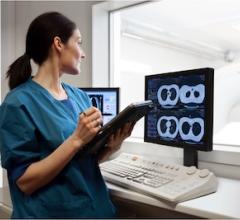
February 26, 2009 - The first 3D imaging results obtained with a new imaging technology called Magnetic Particle Imaging (MPI) produced reportedly unprecedented real-time images of arterial blood flow and volumetric heart motion, reported Royal Philips Electronics.
The technology uses the magnetic properties of iron-oxide nanoparticles injected into the bloodstream and has been used in a pre-clinical studies. This is said to represent a major step forward in taking Magnetic Particle Imaging from a theoretical concept to an imaging tool to help improve diagnosis and therapy planning for many of the world’s major diseases, such as heart disease, stroke and cancer. The results of the pre-clinical study were published in issue 54 of Physics in Medicine and Biology (2009).
“A novel noninvasive cardiac imaging technology is required to further unravel and characterize the disease processes associated with atherosclerosis, in particular those associated with vulnerable plaque formation which is a major risk factor for stroke and heart attacks,” said Professor Valentin Fuster, M.D., Ph.D., director of the Mount Sinai Heart Center, New York. “Through its combined speed, resolution and sensitivity, Magnetic Particle Imaging technology has great potential for this application, and the latest in-vivo imaging results represent a major breakthrough.”
According to Henk van Houten, senior vice president of Philips Research and head of the Healthcare research program, “By adding important functional information to the anatomical data obtained from existing modalities such as CT and MR, Philips’ MPI technology has the potential to significantly help in the diagnosis and treatment planning of major diseases such as atherosclerosis and congenital heart defects.”
Philips’ Magnetic Particle Imaging uses the magnetic properties of injected iron-oxide nanoparticles to measure the nanoparticle concentration in the blood. Because the human body contains no naturally occurring magnetic materials visible to MPI, there is no background signal. After injection, the nanoparticles therefore appear as bright signals in the images, from which nanoparticle concentrations can be calculated. By combining high spatial resolution with short image acquisition times (as short as 1/50th of a second), Magnetic Particle Imaging can capture dynamic concentration changes as the nanoparticles are swept along by the blood stream. This could ultimately allow MPI scanners to perform a wide range of functional cardiovascular measurements in a single scan. These could include measurements of coronary blood supply, myocardial perfusion, and the heart’s ejection fraction, wall motion and flow speeds.
The results obtained from Philips’ experimental MPI scanner mark an important step towards the development of a whole-body system for use on humans. Some of the technical challenges in scaling up the system relate to the magnetic field generation required for human applications. Others lie in the measurement and processing of the extremely weak signal emitted by the nanoparticles. Signal measurement and processing are areas where Philips has a great deal of proven expertise and experience that it is currently applying to the task.
The scientific article “Three-dimensional real-time in vivo magnetic particle imaging” published in issue 54 of Physics in Medicine and Biology (2009) can be downloaded from http://stacks.iop.org/0031-9155/54/L1.
For more information: www.medical.philips.com

 August 17, 2026