July 20, 2012 — The ability to see inside the arteries of vascular disease patients in high resolution before and during stenting procedures can offer valuable information. A new study of optical coherence tomography (OCT) in the Journal of Endovascular Therapy confirms the safety and feasibility of this imaging technique in the carotid arteries. A number of physicians lend their support to OCT as a means of gaining more knowledge of cardiac disease and improving the stenting procedure. However, because of cost issues, OCT still has a long road to travel to become widely utilized.
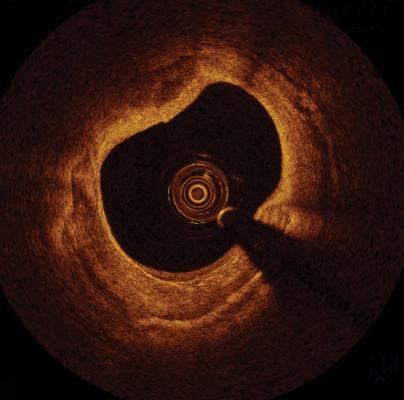
OCT is an invasive intravascular imaging system that produces high-resolution images using light rather than ultrasound. Its resolution is 10 times higher than that of any other clinically available diagnostic imaging method, and it can provide images of tissues at nearly histological resolution. Limitations of OCT include interference by blood flow and the degree of tissue penetration it can achieve.
In the current study, 25 patients undergoing carotid artery stenting also underwent OCT before stent deployment, immediately after stent placement and following post-dilation of the stent. The OCT technique had a success rate of 97.3 percent, and no complications occurred for the patients during the procedure or while in the hospital.
Through the use of OCT in the study, physicians were able to see rupture of the fibrous cap, plaque prolapse and stent malapposition in patients. As authors of the commentaries note, future applications could reveal further details that increase understanding of carotid stenting and influence clinical policies regarding its use.
Carotid artery stenting has not reached its predicted potential, in part owing to a lack of reimbursement in the United States and mixed results from European trials. OCT may provide evaluation of critical aspects of carotid artery stenting. Additionally, more evidence from OCT clinical research could help health authorities realize the value of the carotid artery stenting procedure.
For more information: www.jevt.org

 August 28, 2026