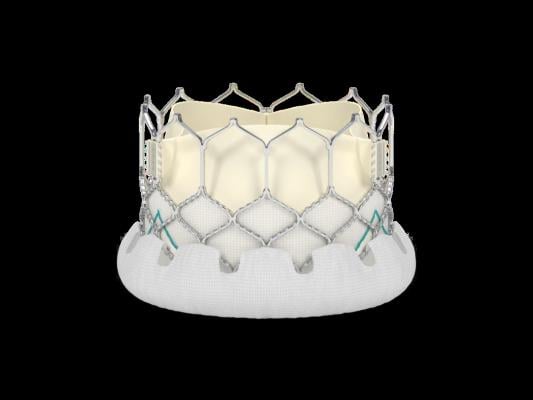
October 31, 2017 — Edwards Lifesciences Corp. announced new data demonstrating substantial economic advantages of the Edwards Sapien 3 transcatheter aortic heart valve for patients suffering from severe, symptomatic aortic stenosis (AS) who are at intermediate risk for open-heart surgery. Results of the economic analysis, which is the first-of-its-kind report on intermediate-risk patients, were presented as a late-breaking clinical trial at the 29th Transcatheter Cardiovascular Therapeutics (TCT), the annual scientific symposium of the Cardiovascular Research Foundation, Oct. 29-Nov. 2 in Denver.
The economic analysis of the SAPIEN 3 valve compared to surgery involved more than 2,000 patients enrolled in both the PARTNER IIA Trial and the SAPIEN 3 intermediate risk trial. The analysis showed significantly lower total one-year costs, on average, with the Sapien 3 valve compared with surgical aortic valve replacement ($80,977 versus $96,489). Average index hospitalization costs — which include the costs of the procedure, hospital stay and physician fees — were also lower with the Sapien 3 valve versus surgery ($54,256 vs. $58,410). Reduced length of stay, simpler, more efficient procedures, fewer repeat hospitalizations and less time in rehabilitation contributed to the economically dominant results of the Sapien 3 valve. Transcatheter aortic valve replacement (TAVR) with the Sapien 3 valve added 0.27 quality-adjusted life years (QALY) per patient at a lifetime cost savings of approximately $10,000 compared with surgery. The SAPIEN 3 intermediate risk trial enrolled patients during 2014.
"Based on both clinical and economic considerations, these findings demonstrate that TAVR should be the preferred strategy for patients with severe aortic stenosis at intermediate surgical risk," said David J. Cohen, M.D., professor of medicine at the University of Missouri-Kansas City and director of cardiovascular research at Saint Luke's Mid America Heart Institute, who presented the study results. "Taken together with previous data demonstrating excellent clinical outcomes and significantly improved quality of life with TAVR, this latest study shows that TAVR with the Sapien 3 valve also provides important short and long-term economic advantages compared with surgery."
The researchers also performed an analysis of the Sapien XT valve compared with surgery, using data from the randomized PARTNER II A Trial on 1,938 patients enrolled from 2011 to 2013. According to the researchers, over a lifetime, TAVR with the Sapien XT valve was also projected to be an economically dominant strategy, providing both greater quality-adjusted life expectancy and lower long-term costs than surgery, with a high degree of confidence. The Sapien XT valve is no longer utilized in clinical practice in the United States; instead, the next-generation Sapien 3 is utilized in the U.S. and most other geographies worldwide.
The Sapien 3 valve was approved by the U.S. Food and Drug Administration (FDA) in 2015 for severe, symptomatic aortic stenosis patients at high risk for open-heart surgery, and, in 2016, received approval for the treatment of patients who are at intermediate risk for open-heart surgery.
Cohen is a consultant to Edwards Lifesciences. The PARTNER II Trial was sponsored by Edwards Lifesciences.
For more information: www.tctconference.com
Related TCT Content
TCT Announces 2017 Late-breaking Clinical Trial Presentations

 August 28, 2026