News | Remote Monitoring | January 26, 2016

Japanese Researchers Catch Heartbeats With Millimeter-Wave Radar

Kyoto University and Panasonic Corp. demonstrate new remote-sensing technology

Kyoto University, Panasonic, remote heartbeat sensing, millimeter-wave radar

January 26, 2016 β€” Heartbeats can now be measured without placing sensors on the body, thanks to a new technology developed in Japan. Researchers at the Kyoto University Center of Innovation, together with Panasonic Corp., have come up with a way to measure heartbeats remotely, in real time, and under controlled conditions with as much accuracy as electrocardiographs.

The researchers say this will allow for the development of "casual sensing" β€” taking measurements as people go about their daily activities, for instance, when they are going to bed or getting ready to start the day.

"Taking measurements with sensors on the body can be stressful and troublesome, because you have to stop what you're doing," said Hiroyuki Sakai, a researcher at Panasonic. "What we tried to make was something that would offer people a way to monitor their body in a casual and relaxed environment."

The added convenience of remote sensing, the team believes, will be an incentive for people to monitor their health status for their own benefit.

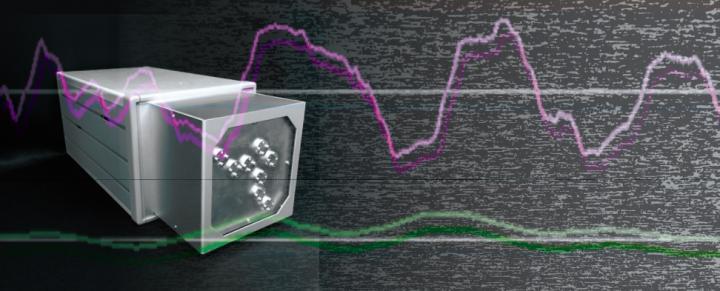
The remote sensing system combines millimeter-wave spread-spectrum radar technology and a unique signal analysis algorithm that identify signals from the body.

"Heartbeats aren't the only signals the radar catches. The body sends out all sorts of signals at once, including breathing and body movement. It's a chaotic soup of information," said Toru Sato, professor of communications and computer engineering at Kyoto University. "Our algorithm differentiates all of that. It extracts waves characteristic of heart beats from the radar signal and calculates their intervals."

The team hopes the remote sensing system, with further experimentation, will be put to practical use in the near future.

"Now that we know that remote sensing is possible, we'll need to make the measurement ability more robust so that the system can monitor subjects in various age ranges and in many different contexts," Sato concluded.

For more information: www.kyoto-u.ac.jp/en


Related Content

News | Remote Monitoring

Sept. 16, 2025 β€” PaceMate has appointed Sean Shoffstall as Head of AI, Innovation and Data Strategy. Shoffstall joins ...

Home September 16, 2025
Home
News | Remote Monitoring

August 14, 2025 β€” PaceMate has officially completed a year-long project, resulting in two new exclusive abilities. The ...

Home August 14, 2025
Home
Feature | Remote Monitoring | Arnaud Rosier

As healthcare systems continue to shift toward value-based care and proactive disease management, remote monitoring has ...

Home June 11, 2025
Home
News | Remote Monitoring

April 28, 2025 β€” iRhythm Technologies, Inc. recently announced results from a large real-world retrospective analysis ...

Home April 29, 2025
Home
Feature | Remote Monitoring | By Stuart Long

In a room of 20 people, it’s likely that about 10 of them, or half, will presently have some form of cardiovascular ...

Home July 10, 2024
Home
Feature | Remote Monitoring | By Arnaud Rosier, MD, PhD

This past spring, electrophysiology experts issued new recommendations for remote monitoring of cardiovascular ...

Home November 20, 2023
Home
News | Remote Monitoring

November 9, 2023 β€” According to a recent survey of healthcare providers (HCPs), 93 percent of clinicians are currently ...

Home November 09, 2023
Home
News | Remote Monitoring

July 21, 2023 β€” AliveCor, a leading innovator in FDA-cleared personal electrocardiogram (ECG) technology, today ...

Home July 21, 2023
Home
News | Remote Monitoring

July 11, 2023 β€” FIRE1 announced that the first U.S. patients have been successfully implanted with its FIRE1 System for ...

Home July 11, 2023
Home
News | Remote Monitoring

June 21, 2023 β€” Qardio, a leading innovator in healthcare technology, has unveiled its groundbreaking Livestream ...

Home June 21, 2023
Home
Subscribe Now