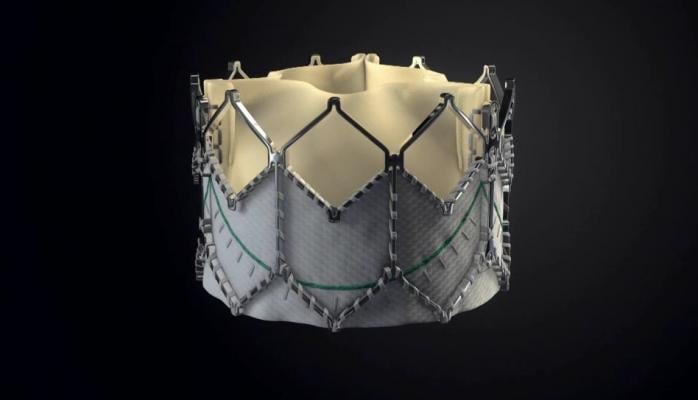
November 1, 2016 — Edwards Lifesciences Corp. announced new five-year hemodynamic data from the PARTNER Trial demonstrating excellent durability of the first-generation Edwards Sapien transcatheter heart valve (THV). This evaluation of 2,404 patients, encompassing 10,560 echoes and 6,493 patient years of follow-up, is the largest core lab based study of transcatheter heart valves to date.
Findings from the PARTNER II QUALITY OF LIFE study were reported during the late-breaking clinical trials session at the 28th Transcatheter Cardiovascular Therapeutics (TCT), the annual scientific symposium of the Cardiovascular Research Foundation, in Washington, D.C.
"In the largest, most robust study of its kind, population hemodynamic trends show excellent durability of the Sapien transcatheter heart valve over five years, with virtually no structural valve deterioration," said Pamela Douglas, M.D., Ursula Geller professor of research in cardiovascular disease at Duke University and director of the Imaging Program at Duke Clinical Research Institute, who presented the data. "Similarly, large adverse hemodynamic echo findings in individual patients are rare in this protocol-driven database. Together, these data demonstrate excellent mid-term durability of THV, suggesting that the low five-year survival observed in this cohort is not due to adverse hemodynamics."
Using three standard echocardiographic parameters, the study assessed hemodynamics (at 7 days, 30 days, 6 months, 1 year, 2 years, 3 years, 4 years and 5 years post-implant) and related the findings to clinical events of death and aortic valve re-intervention.
Between 2011 and 2013, 2,032 intermediate risk patients with severe AS were randomized to TAVR with the SAPIEN XT valve (n=1,011) or SAVR (n=1,021) in the PARTNER II Trial. Quality of life was assessed on all patients at baseline, one, 12 and 24 months using the Kansas City Cardiomyopathy Questionnaire (KCCQ), SF-36 and EQ-5D.
The study found that at two year follow-up, both TAVR and SAVR were associated with clinically and statistically significant improvements in disease-specific and generic QoL measures as compared with baseline. The two year change in KCCQ Overall Summary Score was 19.2 points with TAVR compared with 18.3 points for SAVR. Similarly, the two year change in the SF-36 Physical Component Summary Score was 3.0 points with TAVR versus 2.7 points with SAVR. In contrast, at one month, TAVR was associated with significantly better QoL than SAVR, but this difference was restricted to patients who were treated via transfemoral (TF) access and was not seen in patients that were treated via alternative (transapical or transaortic) access (p<0.01 for interaction). There were no significant differences between TAVR and SAVR in any QoL measures at one year or two years.
“This study shows that among intermediate risk patients with severe AS, quality of life improved significantly and to a similar extent with TAVR and SAVR through two years. However, transfemoral (but not transthoracic) TAVR was associated with a substantial and clinically important early health status benefit compared with SAVR.,” said lead investigator David J. Cohen, MD, MSc Director of Cardiovascular Research at Saint Luke's Mid America Heart Institute in Kansas City, Mo. “We believe that these early differences in quality of life may be important to many patients who are suitable candidates for both procedures. Longer term follow up is needed to assess the durability of quality of life improvement with TAVR versus SAVR in this intermediate risk population.”
The PARTNER II trial was funded by Edwards Lifesciences. Cohen reports research grant support from Edwards Lifesciences, Medtronic, Abbott Vascular, and Boston Scientific, and consulting income from Medtronic and Abbott Vascular.
For more information: www.crf.org/tct

 August 28, 2026