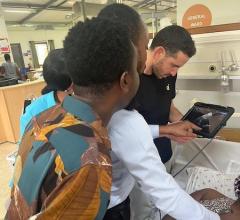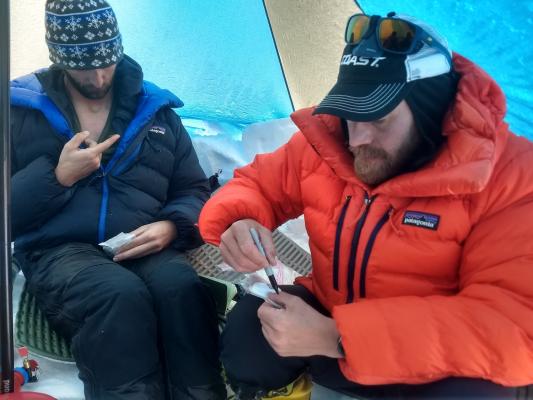
David R. Ohlson, DO (right), logs patient cardiac information and labels a used Cardea Solo ECG sensor while USX climber Adam Storck (left) replaces his sensor at Denali's 14,200-foot camp. Photo courtesy of Ron Oliver, USX.
August 24, 2018 — U.S. Expeditions and Explorations (USX) and Cardiac Insight Inc. announced the successful completion of an expedition on North America’s highest mountain, Denali, to gather data on sudden cardiac death (SCD) risk at high altitudes using the Cardea Solo device.
In older men, especially those unaccustomed to intense physical exertion and with coronary artery disease (CAD) risk factors, there is a higher risk of SCD on the first day of exercise at altitude. This statistic encouraged a mountaineering team, comprised of military members, veterans and a physician, from non-profit organization USX and Cardiac Insight to gather more data and help the millions who recreate at high altitudes.
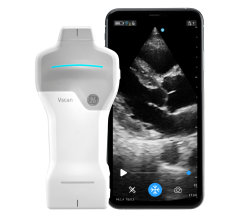
The Cardea Solo from Cardiac Insight is a wearable, wire-free electrocardiogram (ECG) sensor and analysis software system for the detection of adult arrhythmias, including atrial fibrillation (AFib).
SCD is the most common cause of non-traumatic death in men over 34 while skiing or hiking at high altitude. Researchers believe high altitude increases the likelihood of cardiac arrhythmias. Most of these are benign, however in those with CAD risk factors, arrhythmia could be related to the increased risk of SCD. However, limited data on this subject exists, especially with participants ranging above 5,000 meters (16,404 feet). The Cardea Solo wearable sensor, which records every heartbeat for up to seven days, provides the capability to capture high-fidelity data in this challenging environment in an unobtrusive, comfortable form factor.
“We are pleased to report that because of the durability and ease-of-use of the Cardea Solo Sensor and its associated software capabilities, we were able to easily secure a large amount of data,” said David R. Ohlson, DO, director of research initiatives for USX, co-chief resident of internal medicine at Bingham Memorial Hospital in Blackfoot, Idaho, and an accomplished climber and filmmaker. “The continuous nature of the 28 days of data we captured will help provide new insights into how frequently abnormal heart rhythms occur in healthy individuals at high altitude and give us a model for larger studies in the future.”
The Cardea Solo ECG System records, stores and analyzes every heartbeat. The latest version of the software also features batch file analysis capabilities. Researchers own and control all their data, and study participant compliance with Cardea Solo wear time of up to seven days has been reported as excellent, according to the company.
For more information: www.cardiacinsightinc.com

 March 04, 2026