March 21, 2019 — Clinicians should use echocardiography when determining whether patients with heart failure and a leaking heart valve are likely to benefit from valve repair, according to research presented at the American College of Cardiology’s 68th Annual Scientific Session, March 16-18 in New Orleans.
The new study offers additional insights on the COAPT trial, which investigated the use of transcatheter mitral valve repair (TMVR) in patients with secondary mitral regurgitation, a condition where the mitral valve does not close properly due to problems with the heart’s pumping chambers. In 2018, COAPT researchers reported that patients undergoing TMVR with the MitraClip device had significantly better rates of survival at two years compared to those receiving standard medications alone.
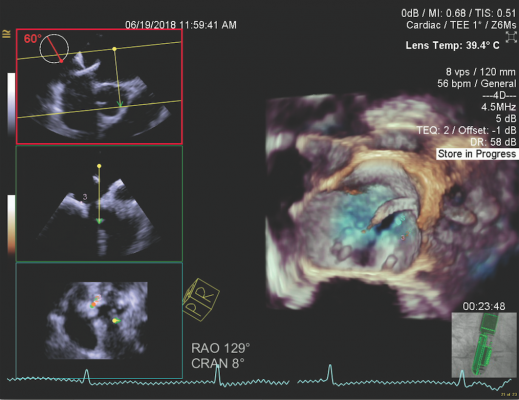
To help translate COAPT’s findings into practical guidance for clinical decisions, the new study details how echocardiography can be used to diagnose secondary mitral regurgitation. The new study also explains how the researchers used a multi-parametric algorithm adapted from the American Society of Echocardiography and ACC guidelines to determine which patients were eligible to participate in the study and track the valve’s function over the course of two years. While clinicians routinely use echocardiograms when assessing mitral regurgitation, there is no worldwide standard for diagnosing secondary mitral regurgitation with this tool, limiting its application. As a result, details on the study methodology are important for informing clinical practice, researchers said.
“We found echocardiography is valuable for assessing patients with secondary mitral regurgitation on multiple levels,” said Federico Asch, M.D., director of the Echocardiography Core Lab at MedStar Health Research Institute, associate professor of medicine at Georgetown University and the study’s lead author. “Echocardiography should be used to determine which patients are candidates for TMVR, and it should also be used after MitraClip implantation to see the results of the procedure.”
Hear more about the study in the VIDEO: Echocardiographic Findings in the COAPT Trial — Interview with Federico Asch, M.D.
COAPT enrolled 614 patients treated at 78 medical centers in the U.S. and Canada. Patients were randomly assigned to receive the MitraClip or maximally tolerated medical therapy as recommended by clinical guidelines, which typically includes diuretics, beta blockers and other medications, and sometimes cardiac resynchronization therapy (a pacemaker). All participants had heart failure and moderate to severe secondary mitral regurgitation at the start of the trial. Heart failure is a condition in which the heart is too weak to pump enough blood to meet the body’s needs. Secondary mitral valve regurgitation frequently coexists with heart failure, worsens patients’ symptoms, and affects their quality of life and survival.
Researchers used echocardiography to image participants’ hearts before enrollment and during follow-up visits at one, six, 12, 18 and 24 months. They developed an algorithm that was used by expert echocardiographers to interpret the heart images, evaluate the functioning of the valve and determine whether patients were appropriate candidates for the MitraClip procedure. Follow-up assessments revealed that the repaired valve was effective at preventing backward flow of blood through the valve (mitral regurgitation), and that this effect persisted throughout the two years of follow-up.
In addition, the study focused on identifying characteristics of the heart, measurable with an echocardiogram, that may predict which patients would have a better or worse response to TMVR. In this analysis, researchers found that TMVR was equally beneficial across all subgroups analyzed, including the size, function or pressures of the heart’s chambers, leading them to conclude that all patients with similar characteristics to those in the trial should be considered for this intervention.
“MitraClip was shown to be beneficial in the study population in all sub-groups analyzed, regardless of patients’ echocardiographic characteristics,” Asch said. “While we learned that patients with higher pulmonary hypertension are at higher risk after they receive the MitraClip, they still do better than if they would not have had the intervention done. Doing an echocardiogram is critical in determining if a patient is a good candidate for MitraClip and in following these patients to evaluate results of the procedure in the long run.”
The study was funded by Abbott.
Read more about late-breaking trials from ACC.19.
For more information: www.abbott.com

 April 02, 2026