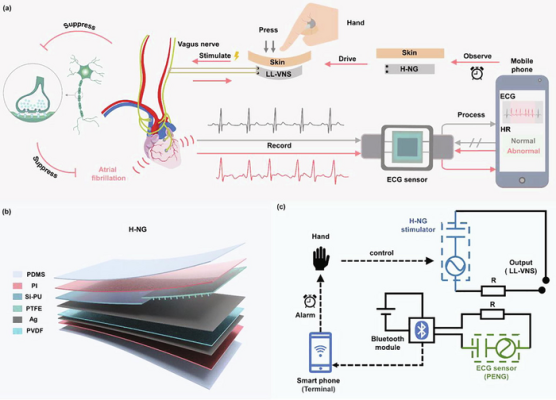
Based on the flexible, miniaturized, and self-powered characteristics of the H-NG, an closed-loop system for AF monitoring and treatment through LL-VNS was designed. (a) Illustration of the H-NG based closed-loop self-powered LL-VNS system. (b) Structure of H-NG. (c) Circuit diagram of H-NG based closed-loop LL-VNS system. ©Science China Press
July 6, 2022 — Atrial fibrillation (AF) is a prevalent cardiovascular condition with one of the highest rates of morbidity and death worldwide. The mechanism of AF reveals that the interaction between AF and the remodeling of the autonomic nervous system constitutes a vicious circle and exacerbates the condition rapidly. A number of studies have applied low-level vagus nerve stimulation (LL-VNS) to inhibit AF inducibility. LL-VNS is a promising therapeutic method for AF that can suppress autonomic nervous system remodeling to prevent a vicious circle. However, some fundamental challenges remain in terms of flexibility, miniaturization, and long-term service of bioelectric stimulation devices. These issues also have an impact on the future use of LL-VNS.
In this study, the team designed a closed-loop self-powered LL-VNS system based on a hybrid nanogenerator (H-NG) for the routine treatment of patients with AF and tested its stability and biocompatibility. The PENG sensor used by this system extracted pulse waves from the skin and transmitted data through a Bluetooth module. The signal processing module was mostly dependent on mobile phones and applications. It monitored the occurrence of AF by analyzing the pulse waveform to alert the patient in real time. When AF occurs, the wristband sends out a timely warning message. Users can tap this device to exert its anticholinergic effect by suppressing the activity of the vagus nerve, so as to prevent atrial fibrillation inducibility to achieve therapeutic effects.
The H-NG stimulator was an important component of the closed-loop LL-VNS system. It was mainly composed of triboelectric, piezoelectric, and encapsulation modules. Piezoelectric and triboelectric modules were the core components of the H-NG, which converted external mechanical energy into electrical energy. The piezoelectric material was polarized PVDF, and its surface was covered with two Ag electrode layers. For the triboelectric module, the Ag electrode and polarized PTFE were used as two triboelectric layer materials. Additionally, Si-PU was used as a spacer and was half-filled. This design effectively reduced the impact of miscontact on the H-NG and significantly increased the stability of the system. The entire device was packaged with thin PDMS to ensure performance and prevent the device from being invaded by the liquid environment.
In the in vivo effect verification study, the atrial fibrillation duration significantly decreased by 90% after LL-VNS therapy, and myocardial fibrosis and atrial connexin levels were effectively improved. Notably, the anti-inflammatory effect triggered by mediating the NF-κB and AP-1 pathways in their therapeutic system is observed. This work also innovatively used a specially constructed NG as a vagus nerve stimulator and demonstrated that the ultra-low intensity output produced by it can effectively treat AF. Overall, this implantable bioelectronic device is expected to be used for self-powerability, intelligentization, portability for management, and therapy of chronic diseases.
In summary, the closed-loop VNS system has been applied to diseases such as epilepsy and Parkinson’s disease. LL-VNS has a far lower stimulus strength than VNS, which implies less influence on organs and fewer adverse effects. In this closed-loop system, when AF occurs, the patient can be reminded to treat themselves on demand in a timely manner. Meanwhile, the closed-loop LL-VNS based on nanogenerators has excellent antiarrhythmic and anti-inflammatory properties, which can greatly improve the targeting of stimulation therapy. In the future, the system can help to promote the in-home health monitoring and reduce the cost of clinical treatment.
The first authors of the paper are master student Yu Sun (Anhui Medical University) and doctoral student Shengyu Chao (Beijing Institute of Nanoenergy and Nanosystems, Chinese Academy of Sciences), and the corresponding authors are Professor Jun Yang (Peking University), Professor Gengsheng Mao (Anhui Medical University), associate Professor Hongqing Feng (Beijing Institute of Nanoenergy and Nanosystems, Chinese Academy of Sciences) and Professor Zhou Li (Beijing Institute of Nanoenergy and Nanosystems, Chinese Academy of Sciences).
For more information: https://phys.org/partners/science-china-press/

 September 11, 2026