Photo: Ventric Health
Oct. 22, 2025 – Ventric Health, a medtech innovator enabling early detection of heart failure (HF) in a primary care setting, has commenced enrollment in a large study comparing the company’s non-invasive Vivio System with the leading invasive implant to determine their respective abilities to effectively measure HF status over time and enable physicians to reduce patient hospitalizations and death.
Patients with advanced HF at ongoing risk of hospitalization are frequently implanted with a device to measure their HF status. These implants require a costly, invasive procedure, presenting potential health risks. The devices measure pulmonary artery pressure (PAP), which is a surrogate for the gold-standard HF measure of left ventricular end-diastolic pressure (LVEDP).
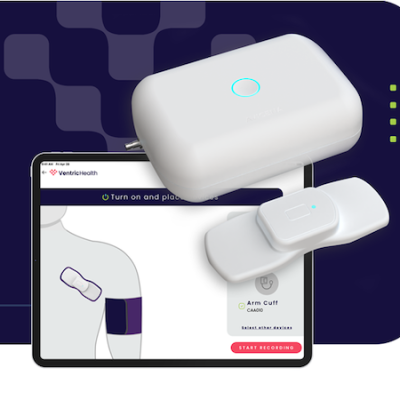
The FDA-approved Vivio System non-invasively measures LVEDP in a simple, five-minute test, with the goal of early HF detection and earlier intervention before quality of life deterioration. The system is portable and entirely non-invasive, allowing for monitoring of patients in the home environment or in the primary care environment.
The new study will compare the Vivio System to the invasive CardioMEMS implant. The study will enroll up to 500 patients at up to 20 sites.
“We are excited to examine how LVEDP measures obtained non-invasively compare to the standard HF proxy measure of PAP obtained invasively. If the Vivio technology proves successful, it has the potential to enable physicians to optimally manage patients with HF and may lead us to reexamine whether an invasive procedure is necessary to achieve the same clinical outcomes,” said Kevin Shah, MD, principal investigator of the study, Advanced Heart Failure and Transplant Cardiologist, and Director of Heart Failure Outreach at Memorial Care Heart and Vascular Institute, Long Beach, California.
“The Vivio System is designed to be quick and simple to use, enabling wider access to HF detection and monitoring in both a primary care setting and potentially at home, as will be explored in this study. Empowering patients to easily and accurately monitor their own HF status, without the risks associated with an invasive device, presents an intriguing alternative that could benefit both physicians and their patients, and improve cost-effectiveness in the healthcare system,” said Sean Brady, CEO of Ventric Health.
Go to www.ventrichealth.com for more information.
 September 11, 2026