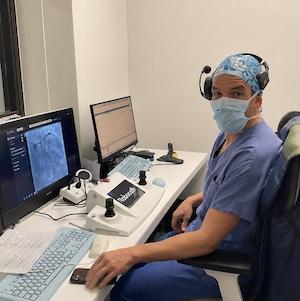
Dr. Mohammed Nejjari (pictured above) alongside
Dr. Franck Digne conducted the study at the
Centre Cardiologique du Nord (CCN) in
Saint-Denis, France. (Photo: Robocath)
May 11, 2026 — In May, Robocath announced the completion of patient enrollment in the FIH (First-In-Human) clinical study evaluating its next-generation robotic system for percutaneous coronary interventions (PCI).
Conducted at the Centre Cardiologique du Nord (CCN) in Saint-Denis, France, and led by Dr. Mohammed Nejjari, principal investigator, alongside Dr. Franck Digne, the study assessed the feasibility and safety of Robot-Assisted Percutaneous Coronary Intervention (RA-PCI) using Robocath’s next-generation system in patients with coronary artery disease.
"Completing enrollment in this First-In-Human study is a defining moment in the field of interventional cardiology,” said Dr. Mohammed Nejjari. “For the first time, we have demonstrated that robotic assistance can be safely and reliably applied to the full spectrum of coronary lesion complexity, including the most challenging anatomies. This is not a glimpse into the future: it is the future, starting now."
Second Generation Robotic Platform
Robocath’s second-generation robot leverages the clinical and technological experience from its first robotic platform, now used in centers worldwide, and integrates advanced capabilities such as multi-device handling to support increasingly complex coronary procedures.
The study included 20 patients (≥ 18 years old) with coronary artery disease, primarily complex cases seen in real-world catheterization laboratory practice. They were stratified by coronary lesion complexity across three subgroups:
- Type A/B1 lesions: 6 patients
- Type B2 lesions: 7 patients
- Type C lesions: 7 patients
To date, no safety concerns have been reported in connection with the use of Robocath’s system. Technical outcomes observed across all lesion subgroups - including complex Type B2 and Type C anatomies - are considered promising.
“Congratulations to Dr. Mohammed Nejjari and the CCN team for completing full-patient enrollment in this study, a worldwide first-of-its-kind achievement,” said Philippe Bencteux, CEO of Robocath. “This is a key milestone in validating our unique technology, designed to transform PCI management across all levels of complexity. We remain committed to advancing coronary artery disease care, the world’s leading cause of death, while improving the daily practice of healthcare professionals.”
These early findings support the potential of Robocath’s next-generation system to address a broad spectrum of coronary artery disease presentations, including patients with challenging anatomical characteristics. Full data analysis and detailed results will be presented in the near-term in forthcoming scientific communications.
The global vascular interventional robot market was valued at $61.1 million in 2024. This is projected to grow from $78.3 million in 2025 to $297 million by 2031, exhibiting a CAGR of 26% during the forecast period. The market growth is driven by increasing demand for minimally invasive surgeries, technological advancements in robotic systems and the rising prevalence of cardiovascular diseases, further strengthening Robocath’s market positioning.


 August 28, 2026