Photo: Getty Images
June 10, 2026 — New research shows that patients with peripheral artery disease (PAD) who adhere to pre-operative guideline-directed care (GDC), including documentation of severe lifestyle limitation, exercise therapy and optimal medical therapy, are more likely to remain free from major adverse limb events (MALE) for up to two years after intervention. Researchers from the Medical University of South Carolina presented novel evidence demonstrating the impact of guideline-directed care for patients with claudication at the Society for Vascular Surgery’s Vascular Annual Meeting, VAM26.
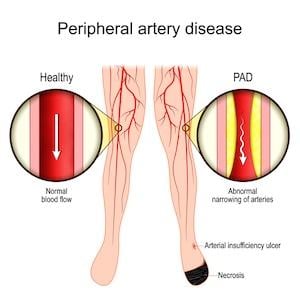
PAD affects over 200 million people worldwide and occurs when narrowed arteries reduce blood flow to the limbs, most commonly in the legs. Approximately one in five patients with PAD develops claudication — symptoms include muscle pain or cramping during physical activity that subsides with rest. Patients with PAD are at increased risk for MALE, which may result in amputation or the need for repeat limb procedures. Although current treatment guidelines recommend lifestyle modification, exercise therapy, smoking cessation, and medical therapy before surgical intervention, many patients do not receive the full spectrum of recommended care.
“Our study was designed to establish the evidence of a comprehensive multidisciplinary approach before considering surgical intervention,” said Dr. Richard Shi, vascular surgery resident at the Medical University of South Carolina. “Too often, surgery is viewed in isolation rather than as one part of a broader continuum of care. By highlighting the role of pre-operative guideline-directed care over immediate intervention or intervention in isolation, we hope to encourage more coordinated care pathways and improved patient outcomes.”
Adherence to GDC
Researchers evaluated whether adherence to GDC before surgical intervention is associated with improved long-term limb outcomes. Adherence was evaluated across three components: 1) documentation of severe lifestyle-limiting symptoms, 2) adherence to optimal medical therapy (OMT), including single antiplatelet therapy, lipid-lowering therapy, and smoking cessation, and 3) completion of exercise therapy. Exercise therapy was defined as participation in either a supervised exercise program or a structured home walking program prescribed by a vascular surgeon or physical therapist, completed for at least three months before intervention. The primary outcome was freedom from MALE over two years following treatment.
The study enrolled 258 patients, all of whom underwent surgery. The researchers compared post- procedural outcomes based on the degree of adherence to GDC. Among the study population, 12.8% demonstrated non-adherence to GDC, 73.3% demonstrated partial adherence (OMT only), and12.8% demonstrated complete adherence. At two years, MALE occurred in 23.3% of patients primarily due to re-interventions. Kaplan-Meier analysis demonstrated that patients with non-adherence had a MALE-free survival rate of 66.6%, compared with 76.7% among partially adherent patients and 87.9% (p < 0.01) among patients with complete adherence to GDC.
“This study highlights the important role vascular surgeons and interventionalists have in ensuring that patients meet the full continuum of pre-operative guideline-directed care before offering surgery,” said senior author Dr. Adam Tanious, MBA, MMSc, FACS, FSVS, Associate Professor within the Division of Vascular Surgery at the Medical University of South Carolina. “These findings reinforce the importance of surgical appropriateness in claudicants and emphasize the need for established guidelines and pathways to direct care for this patient population.”
To combat non-adherence, the authors have developed an electronic health record-based clinical pathway to help claudicants receive guideline-directed care prior to surgery. They are currently running a prospective study at MUSC with over 100 patients enrolled and aim to present this data at future society meetings.

 August 28, 2026