Photo: Abbott
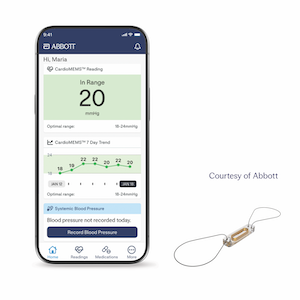
Oct. 5, 2026 — Abbott has announced U.S. Food and Drug Administration (FDA) approval for updates to the CardioMEMS HF System that enable new patient-facing capabilities through the CardioGuide HF App. For the first time, care teams can allow U.S. CardioMEMS patients to view their pulmonary artery pressure (PAP) readings directly on their smartphones, giving them greater insight into their condition and helping them take a more active role in their care.
Heart failure can worsen long before symptoms become noticeable. Pulmonary artery pressure — the pressure of blood flowing from the heart to the lungs — can rise as heart failure worsens, often weeks before patients experience any symptoms. The CardioMEMS HF System, which has been shown to reduce heart failure hospitalizations2,3 and mortality risk4,5, measures pulmonary artery pressure through an implanted sensor in the pulmonary artery. For more than a decade, clinicians have used pulmonary artery pressure readings from the CardioMEMS HF System to help identify signs of worsening heart failure and guide treatment.
Building on that clinical experience with CardioMEMS, Abbott is continuing to evolve heart failure management with digital tools that help keep clinicians and patients connected between office visits. The CardioMEMS HF System with the CardioGuide HF App represents an important step toward helping patients take an earlier, more active role in understanding and managing their heart failure.
"Heart failure can worsen before patients notice shortness of breath, swelling or weight gain. Pulmonary artery pressure readings can help identify changes earlier, giving care teams an opportunity to adjust treatment before symptoms develop," said Andrew J. Sauer, M.D., cardiologist and vice president for research at Saint Luke's Mid America Heart Institute and professor of medicine at the University of Missouri-Kansas City. "By giving patients access to their pressure trends and personalized guidance from their care team, the CardioGuide HF App can help patients better understand their condition, understand why treatment adjustments are recommended, and take a more active role in managing their heart failure."
The new CardioMEMS HF System capabilities also include Dynamic Treatment Plan (DTP), a software feature that allows clinicians to set up personalized medication adjustment plans based on changes in a patient's pulmonary artery pressure. Once in place, DTP can send medication adjustment instructions directly to CardioMEMS patients through the CardioGuide HF App, ensuring patients receive timely feedback and guidance from their care team.
"Abbott is reshaping heart failure care by bringing meaningful, actionable information directly to patients," said Katie Spayde, vice president of Abbott's heart failure division. "For many people living with heart failure, managing their condition is part of everyday life. By giving patients greater visibility into their condition, these new capabilities help them stay informed, engaged and connected to their care between doctor visits."
Abbott plans to make CardioGuide HF App and Dynamic Treatment Plan available later this year.
- Abbott. Data on file.
- Heywood JT, Zalawadiya S, Bourge RC, et al. Sustained reduction in pulmonary artery pressures and hospitalizations during 2 years of ambulatory monitoring. J Card Fail. 2023;29(1):56–66. doi: 10.1016/j.cardfail.2022.10.422.
- Adamson PB, Abraham WT, Stevenson LW, et al. Pulmonary artery pressure-guided heart failure management reduces 30-day readmissions. Circ Heart Fail. 2016;9(6):e002600. doi:10.1161/CIRCHEARTFAILURE.115.002600.
- Lindenfeld J, Costanzo MR, Zile MR, et al., on behalf of the GUIDE-HF, CHAMPION, and LAPTOP-HF Investigators. Meta-Analysis of Implantable Hemodynamic Monitors for HFrEF. Implantable hemodynamic monitors improve survival in patients with heart failure and reduced ejection fraction. J Am Coll Cardiol. 2024;83:682-694. doi:10.1016/j.jacc.2023.11.030.
- Zalawadiya S, Abraham J, Rathman L, et al. Early reduction of pulmonary artery pressures is associated with improved mortality among Medicare beneficiaries with heart failure. JACC Heart Fail. 2025;13(10):102589. doi:10.1016/j.jchf.2025.102589.


 October 21, 2025