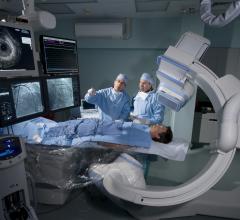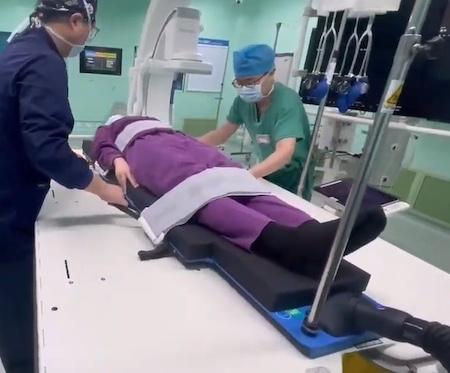
Clinical staff perform a patient transfer using an air-bearing hoverboard
system in an interventional suite. The hoverboard enables seamless
movement between CT and angiography without repositioning the
patient. Photo: Diacor
The clinical case for combining CT and angiography in a single workflow has been settled. Purpose-built mobile imaging systems have already demonstrated it: when an interventional team can move between CT guidance and angiographic intervention without relocating the patient, outcomes improve. Stroke treatment accelerates. Hemorrhagic trauma management improves. Minimally invasive oncology procedures that once required two separate room visits can be completed in one encounter.
The challenge for most hospitals is that workflow has been resource intensive. Until now, integrated CT+Angio capability has been the domain of purpose-built, single-vendor suites requiring significant capital investment and extensive planning and construction.
The imaging modalities hospitals need most have always been physically siloed: separate rooms, separate teams, separate workflows. Air-bearing patient transfer technology does not just move patients. It can connect the workflows.
Many interventional programs already own the components of a functional CT+Angio system. What they have been lacking is the element that integrates the components.
The Patient Is the Thread
Interventional teams working at the leading edge of practice are running into the limits of what single modalities can achieve. CT shows anatomy. Angiography guides intervention. Each is powerful alone. Together, they change what is clinically possible, not just by combining images, but by informing decisions. The right information, at the right moment, in time to change what happens next.
That is the real value of CT+Angio integration. Not efficiency for its own sake. Timely, complementary information that moves clinical decisions forward: what is the status of my patient right now, and what will I do about it.
The patient is the thread that connects these modalities. Moving the patient between them, safely and with consistent positioning, makes combined workflows possible for the hospitals that cannot move the scanner. The question is never whether moving a patient between modalities is easy. The question is whether the clinical information gained is worth it. For stroke, trauma and oncology teams who have done it, the answer is unambiguous.
Air-Bearing Technology
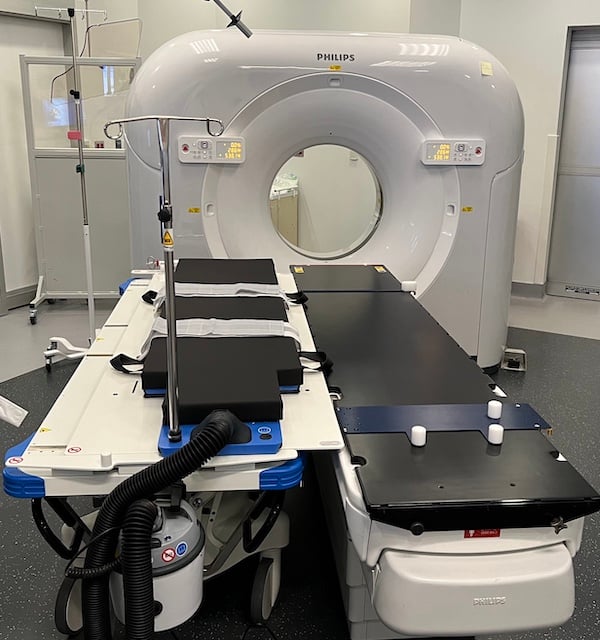
Air-bearing patient transfer technologies, or hoverboards, were originally developed for radiation oncology, where maintaining millimeter-level patient positioning across modalities is non-negotiable. They work by floating a patient on a thin cushion of air across flat surfaces. Clinical staff can transfer even a patient weighing several hundred pounds between tables safely, without repositioning, and with minimal physical strain. The patient's body stays stable. Immobilization devices stay in place. Anesthesia monitoring continues uninterrupted.
Diacor’s Zephyr IR Patient Transfer System is specifically designed for multi-modality, multi-vendor environments, enabling patient transfer between angiography, CT, MR and surgery using a single hoverboard, regardless of equipment manufacturer. That vendor-agnostic architecture is not incidental. It is the core design principle.
And critically, the physical strain on the staff member performing the transfer is a fraction of a manual slide. Peer-reviewed research consistently shows that air-assisted transfer devices significantly reduce lumbar muscle activity, trunk flexion and biomechanical loading compared with manual transfers.* OSHA and NIOSH Safe Patient Handling and Mobility guidelines consistently document fewer musculoskeletal injury claims in departments that adopt mechanical transfer assistance. The hoverboard does not just move patients more safely. It protects the staff who move them.
Breaking Silos Between the CT and Angio Suites
Implementing an integrated CT+Angio workflow with an air-bearing system does not require a new room, new scanner, or new angio system. It requires one hoverboard and a flat table top adapter compatible with the existing CT. If the rooms are adjacent, no architectural modification is required.
This creates a category of customers the market has not served before: the hospital that wants to implement CT+Angio workflows without a major capital expense and construction delay. Clinical teams build real experience, establish workflow protocols, and generate the case volume that either confirms the hoverboard is all they need, or builds the internal justification for a future integrated suite investment. Either way, the hospital wins.
The hoverboard is not a workaround. It is a complete, vendor-agnostic solution that happens to cost a fraction of the alternative, requires no architectural changes, and can be operational in days rather than years. For many hospitals, that is not the entry point. That is the answer.
Every Move Matters
The most forward-thinking radiology administrators do not evaluate individual equipment purchases in isolation. They ask: what assets can grow with our program, adapt to new technology, and keep working when individual systems change?
Designed for flat surface to flat surface transfer, the Zephyr IR becomes the infrastructure layer that connects a hospital's imaging assets, today and as they evolve, without locking into a single vendor or requiring room redesign.
It is not a single-vendor commitment. It is not a room configuration. It is a cost-effective, vendor-agnostic way to achieve modality combinations that were previously out of reach, while protecting the staff who make every transfer happen.
For CT+Angio specifically, that means hospitals do not have to wait for a strategic capital cycle to begin doing the work their interventional teams have been asking for. The combined workflow they want is probably already in their building. They just need the bridge.
* Hwang J, Ari H, Matoo M, Chen J, Kim JH. Air-assisted devices reduce biomechanical loading in the low back and upper extremities during patient turning tasks. Applied Ergonomics. 2020;87:103121. doi: 10.1016/j.apergo.2020.103121.
Authors
Kevin Anderson is president of Diacor, Inc., where he has led the company for more than 15 years. With nearly 25 years at Diacor, Anderson has guided the development and commercialization of air-bearing patient transfer technologies now deployed in more than 400 clinical environments globally, including radiation oncology, intraoperative MRI and hybrid OR programs. He holds a degree from the University of Utah David Eccles School of Business.
Steve Hushek is Clinical Applications Director for iMRI and Multi-Modality at Diacor., where he supports clinical sales, installation and training across the company's multi-modality hybrid OR environments. He is a trained MR physicist with experience in both clinical and corporate settings. His specialties include intraoperative and interventional MRI, multi-modality patient care workflows, and MRI safety.
 October 24, 2025