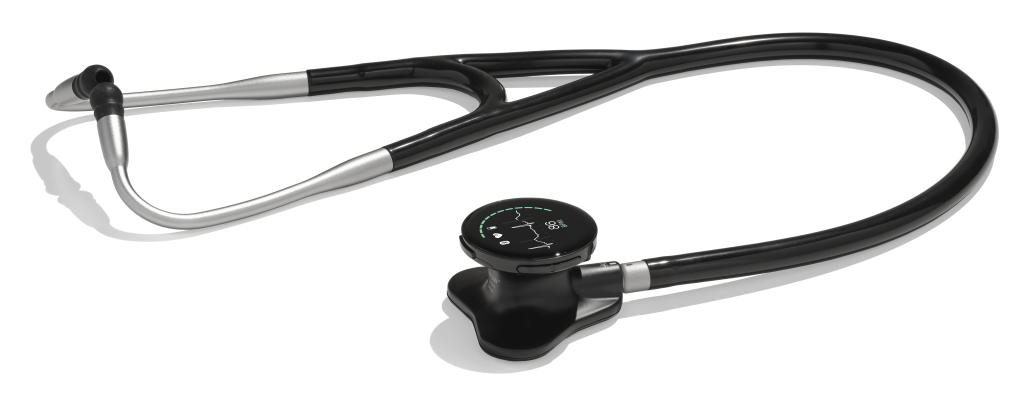
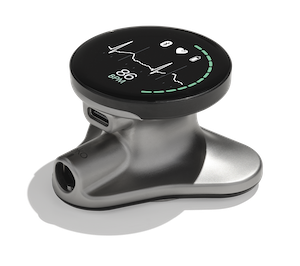
The CORE 500 digital stethoscope combines a three-lead electrocardiogram, enhanced audio clarity, and waveform visualization with connectivity for artificial intelligence insights, exam recording, and sharing. (Photos: Eko Health)
Primary care providers (PCPs) stand on the front lines of diagnosing clinically significant valvular heart disease (VHD). Yet the primary in-office tool clinicians use to diagnose heart valve disease, the traditional stethoscope, shows only 44% sensitivity in detecting murmurs, an early clinical indicator of VHD, leaving many patients with VHD undiagnosed.1
Smart stethoscopes have emerged over the past decade to fill this gap. They combine amplification and artificial intelligence (AI) to improve auscultation and help clinicians detect murmurs with greater accuracy. A recent study shows that one such device, Eko Health’s AI-enabled digital stethoscope, detected murmurs associated with moderate-to-severe VHD with 92.3% sensitivity, compared to 46.2% with traditional stethoscopes in real-world primary care settings.2 Results of the study were published in the European Heart Journal - Digital Health in February.
“In our current state, we’re missing more than half of the patients with VHD,” says the study’s senior author, Rosalie McDonough, MD, MSc, a clinician scientist and director of medical affairs at Eko Health. “Hopefully [with digital stethoscopes], we can catch those patients earlier, treat earlier, and shift the curve from the initial referral or diagnostic stage to an earlier time point.”
A Growing Body of Evidence
The single-arm, single-blinded, prospective study, conducted from June 2021 to May 2023, enrolled 357 patients ages 50 and older at risk for or with known heart disease without a prior VHD diagnosis or history of murmur. Patients were auscultated with both traditional and AI-enabled stethoscopes, using an FDA-cleared AI algorithm that listens for the acoustic patterns associated with valve problems and flags patients who need echocardiogram referrals.
While the European Heart Journal study’s sample size was relatively small, Eko’s AI detection algorithms have been tested in larger, randomized studies. The TRICORDER study, conducted in late 2023 and early 2024, encompassed 206 National Health Service general practices in the United Kingdom caring for 1.5 million patients. The results, published in The Lancet, showed that detection increased by 1.9 times for VHD, 2.3 times for heart failure, and 3.5 times for atrial fibrillation.3
Dr. McDonough envisions Eko participating in future clinical trials focused on longitudinal outcomes data related to early cardiac-related diagnoses. “Our ultimate goal would be to show improved patient outcomes, better care, and then have [a digital stethoscope] embedded into the primary care visit,” she says.
Improving Collaboration
As digital stethoscopes grow in adoption (more than 750,000 Eko devices are in use), they will dramatically change the way PCPs and cardiologists collaborate, says Steven Steinhubl, MD, a practicing cardiologist, clinical researcher, and chief medical officer at Eko Health. “As echocardiography became a predominant aspect of care, we stopped training doctors to be expert auscultators,” he says. “A digital stethoscope can give those providers greater confidence in their cardiac auscultation skills and have a huge impact.”
More accurate auscultation could result in higher-quality referrals, helping cardiology practices run more efficiently. To see how, Dr. Steinhubl gives the example of his practice in Alaska, where the majority of patients have an echocardiogram prior to their cardiology visit. “Having a device that helps primary care providers send patients to the cardiologist with a higher pretest probability could significantly impact on what I and other cardiologists spend our time doing, what kind of patients we see, and our availability to see them,” he says.
Beyond those real-world impacts, Dr. McDonough sees a broader vision of digital stethoscopes helping to close health equity gaps for patients in rural areas who live far from cardiologists. “If we can put an easy-to-use, low-cost tool into the hands of rural providers and give them more insights into their patients’ cardiac function, they can potentially avoid having to send patients on a four-hour drive to see a cardiologist or having to wait four months to get an echocardiogram,” she says.
References
Gardezi SKM, Myerson SG, Chambers J, et al. Cardiac auscultation poorly predicts the presence of valvular heart disease in asymptomatic primary care patients. Heart. 2018;104(22):1832-1835. doi:10.1136/heartjnl-2018-313082
Rancier M, Israel I, Monickam V, et al. Artificial-intelligence-enabled digital stethoscope improves point-of-care screening for moderate-to-severe valvular heart disease. Eur Heart J Digit Health. 2026;7(2):ztag003. Published Feb. 5. doi:10.1093/ehjdh/ztag003
Kelshiker MA, Bächtiger P, Mansell J, et al. Triple cardiovascular disease detection with an artificial intelligence-enabled stethoscope (TRICORDER): design and rationale for a decentralised, real-world cluster-randomised controlled trial and implementation study.
 September 11, 2026