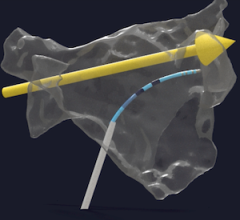
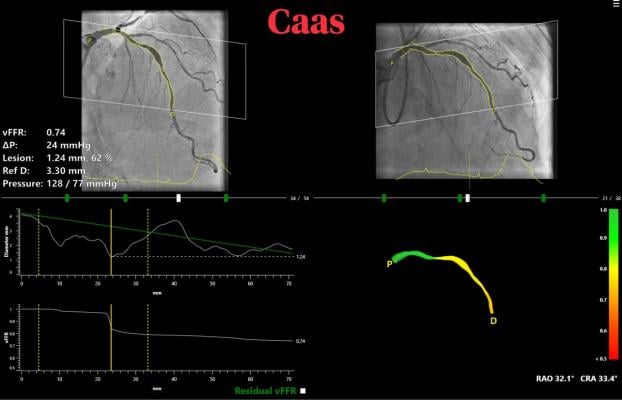
The Pie Medical Imaging angiography-based vessel fractional flow reserve (CAAS vFFR) technology can use angiography imaging alone to assess FFR without the need for pressure wires or adenosine.
January 4, 2022 - Pie Medical Imaging (PMI), a global leader in cardiac imaging, part of the Esaote Group, recently announced the beginning of FASTIII, a multicenter randomized clinical trial investigating the use of angiography-based vessel fractional flow reserve (CAAS vFFR) in patients undergoing coronary revascularization procedures.
The FASTIII trial is led by Dr. Joost Daemen, cardiologist at the Thoraxcenter at the Erasmus University Medical Center, Rotterdam, The Netherlands. It is an investigator initiated international, multi-center randomized, non-inferiority trial aiming to enroll a total of 2228 patients, in seven European countries and 35 hospitals and is sponsored by the European Cardiovascular Research Institute (ECRI).
The FAST III study aims to demonstrate non-inferiority of CAAS vFFR guided revascularization as compared to a conventional invasive wire based FFR guided revascularization in patients with either stable coronary syndrome or non-ST segment elevation myocardial infarction and intermediate coronary artery lesions.
vFFR can assess whether a coronary artery narrowing is functionally severe and requires treatment. CAAS vFFR allows doing so without the need for adenosine or invasive wires that are part of the routine practice to measure FFR pressure gradients.
The high diagnostic accuracy of CAAS vFFR, which calculates pressure drop and vFFR value using angiography images only was recently confirmed by the results of FAST I, FAST Extend and FASTII studies which validated vFFR as an accurate and easy to use tool to assess coronary physiology.
“We are confident that this new study will lead to a broader use of methods based on angiographic images for a safe and accurate assessment of severity and percentage of artery stenosis” said René Guillaume, PMI managing director.
The trial is funded by research grants from Pie Medical Imaging (Maastricht, the Netherlands) and Siemens Healthineers GmbH (Erlangen, Germany).
For more information: www.piemedicalimaging.com
Related Image-based FFR Technology Content:
Image-based FFR May Replace Pressure Wires and Adenosine
7 Trends in Interventional Lab Angiography Systems
New Technology Directions in Fractional Flow Reserve (FFR)
FAST Study Demonstrates High Diagnostic Accuracy of CAAS vFFR
 November 03, 2026