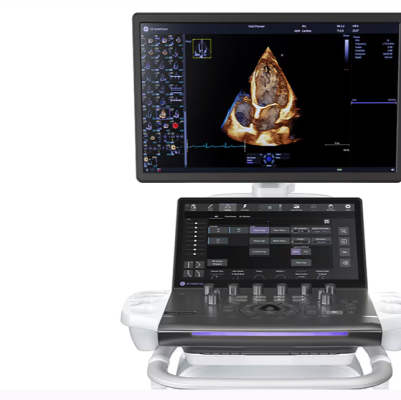
Aug. 29, 2025 — GE HealthCare has launched Vivid Pioneer, its most advanced, ultra-premium and adaptive cardiovascular ultrasound system yet, completely redesigned to support clinicians with imaging in 2D, 4D and color flow, streamlined workflow, and enhanced diagnostic confidence. The ultrasound system recently received CE Mark and U.S. FDA 510(k) clearance.
The Vivid Pioneer is on display during the European Society of Cardiology 2025, Aug. 29–Sept., 1 in Madrid, Spain.
Cardiovascular diseases (CVDs) remain the leading cause of death in the world, accounting for nearly a third of all global deaths[i] Reducing the burden of these diseases can be challenging, as their progression often goes unnoticed due to the asymptomatic nature of many CVDs in the early stages.[ii] Early detection and consistent imaging remain critical challenges in managing complex cardiac conditions but could help reduce the overall burden and alleviate pressure on constrained healthcare environments.
“Vivid Pioneer is built to meet the moment in cardiovascular care where precision, speed, and accuracy are essential,” said Jyoti Gera, Chief Executive Officer, CardioVascular and Interventional Solutions, Advanced Visualization Solutions at GE HealthCare. “With its next-generation imaging engine, AI-powered automation, and intuitive design, the goal of Vivid Pioneer is to empower clinicians to see more, do more, and address patient needs with comfort and confidence.”
Vivid Pioneer is powered by the next-generation cSound™ Pioneer architecture and sophisticated probe technology, for sharp, detailed cardiac imaging. The system produces enhanced spatial and contrast resolution, improved color sensitivity, and exceptional 4D imaging. Its 4Vc-D and new 6Sc-D probes introduced with Vivid Pioneer, built on XDclear™ technology, are designed to enable clinicians to visualize fine anatomical structures and assess cardiac function with a new level of accuracy across a wide range of patients, from pediatrics to adults.
With up to 360% faster AI performance[iii], Vivid Pioneer introduces a suite of intelligent tools that accelerate automation and measurement. The ultrasound system harnesses AI algorithms to reduce inter-operator variability and accelerate workflows, supporting clinicians at every experience level. Tasks that once required manual processes are now automated through features like the newly introduced AI Cardiac Auto Doppler for measurements, Easy AFI that provides strain results and ejection fraction analyses in less than nine seconds[iv], and 4D Auto LHQ for left heart function assessment. These tools can help clinicians obtain consistent results, with the goal of enabling faster diagnoses and more confident decision-making.
“Vivid Pioneer is a fantastic new machine because it brings two very important things for my patients, as a pediatric cardiologist: The first one is extremely good image quality, and the second one is automatic quantification modes for most of my workflow so I can do my scanning very quickly,” said Dr. Ferran Roses[v], Head of Pediatric Cardiology, Vall d’Hebron University Hospital, Barcelona, Spain. “The new features allow us to see in much more detail and to diagnose more precisely.”
Vivid Pioneer is engineered for clinical efficiency and comfort. Its ergonomic design features a simplified user interface, larger screen and customizable touch panel to support workflow continuity and reduce scanning fatigue. The compact, form factor allows clinicians to navigate tight spaces with ease –from echo labs, catheterization labs and bedsides. The onboard battery also enables clinicians to maintain uninterrupted workflow when moving from room to room, allows clinicians to resume scanning instantly without rebooting after a power interruption, and for scanning up to five minutes on battery alone during a power loss.[vi]
To learn more, visit https://www.gehealthcare.com/products/ultrasound/vivid/vivid-pioneer.
[i] World Heart Federation. (2023). World Heart Report 2023: Confronting the world’s number one killer. Geneva, Switzerland. Retrieved from https://world-heart-federation.org/wp-content/uploads/World-Heart-Report-2023.pdf
[ii] Oude Wolcherink, M. J., Behr, C. M., Pouwels, X. G. L. V., Doggen, C. J. M., & Koffijberg, H. (2023). Health Economic Research Assessing the Value of Early Detection of Cardiovascular Disease: A Systematic Review. PharmacoEconomics, 41, 1183–1203. https://doi.org/10.1007/s40273-023-01287-2
[iii] Compared to cSound ADAPT on Vivid E95 v206.
[iv] Time to strain measurement results may vary with heart rate, frame rate and Vivid system. Verification of performance done by GE HealthCare clinical application specialists using the Vivid system.
[v] Dr. Ferran Roses is a paid consultant for GE HealthCare and was compensated for his participation in this testimonial. The statements by Dr. Ferran Roses described here are based on his own opinions and on results that were achieved in his unique setting. Since there is no “typical” hospital/clinical setting and many variables exist, i.e., hospital size, case mix, staff expertise, etc., there can be no guarantee that others will achieve the same results.
[vi] Vivid Pioneer Technical Data Sheet DOC3022122.
 August 28, 2026