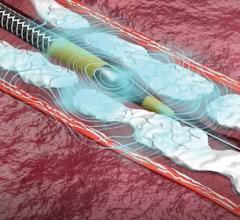
April 5, 2016 — Philips announced that a combined total of more than 5,000 patients have been enrolled in three prospective clinical studies to assess Philips Volcano’s proprietary iFR (instant wave-Free Ratio) measurement technology. The trials will investigate the safety of deferring cardiovascular interventions using iFR versus conventional fractional flow reserve (FFR) measurements.
During catheterization procedures to assess and treat a patient’s coronary arteries, a guide wire is used to obtain measurements of the blood pressure at specific points inside the affected arteries to help assess the severity of the blockage(s). There is a growing body of clinical evidence that the use of FFR in conjunction with interventional X-ray helps improve procedure outcomes and reduces healthcare costs.
FFR and iFR both measure the difference in blood pressure (and by inference the blood flow) through a partially blocked coronary artery (stenosis) to assess whether the blockage is likely to cause a shortage of oxygen to the heart muscle (myocardial ischemia). Both measurements are performed with the aid of a guide wire-based pressure sensor inserted into the appropriate artery via a small incision in the patient’s leg. They differ in that FFR measurements require the injection of a hyperemic agent to dilate the artery, whereas iFR’s ability to synchronize pressure measurements to a ‘wave-free’ period in the patient’s heartbeat means that no hyperemic agent is needed. By eliminating the need for hyperemic agents, iFR offers the benefits of reduced procedure time, cost and complexity.
The combination of these three studies represent one of the largest intra-coronary physiologic data sets ever collected. With more than 5,000 patients studied, all with physiologic guidance, it is more than twice the size of the combined enrollment of the DEFER, FAME and FAME 2 studies which shaped the field of coronary physiology. Further, with nearly 40 percent of the patients in these studies presenting with acute coronary syndrome (ACS), these studies have the potential to expand the use of physiology above its predominant use today.
Two of the studies, DEFINE-FLAIR (Functional Lesion Assessment of Intermediate Stenosis to Guide Revascularization, NCT02053038) and iFR SWEDEHEART (NCT02166736), will assess whether patient outcomes at one year differ when guided by iFR or FFR. The third study, SYNTAX II (NCT02015832), will evaluate the relative treatment outcomes of a hybrid iFR/FFR strategy coupled with intravascular ultrasound (IVUS) guidance, to compare the clinical utility of percutaneous coronary intervention (PCI) versus bypass surgery for three-vessel coronary disease.
Today, many interventional cardiologists using iFR employ a hybrid method for the evaluation of ischemia. When iFR measurements fall within an intermediate ‘gray zone’ (typically 7-14 percent pressure drop), they are followed up with an FFR measurement for confirmation. Clinical trials are needed to establish widely adopted clinical guidelines for iFR that are compatible with current FFR guidelines, in order to widen the use of iFR as a primary diagnostic tool.
“We are all really excited about completing enrollment for the DEFINE-FLAIR, iFR SWEDEHEART and SYNTAX II studies,” said Prof. Patrick W.J.C. Serruys, DEFINE-FLAIR Study chairman and SYNTAX II steering committee chairman, Erasmus MC, Rotterdam, the Netherlands. “Together, these three major clinical outcome studies will more than double the randomized published physiology data, and have the potential to re-shape revascularization guidelines and help physicians perform PCI procedures more likely to benefit their patients.”
Philips showcased its advanced technologies for interventional cardiology at the 2016 American College of Cardiology’s (ACC) Annual Scientific Session and Expo, April 2-4 in Chicago.
For more information: www.philips.com

 August 28, 2026